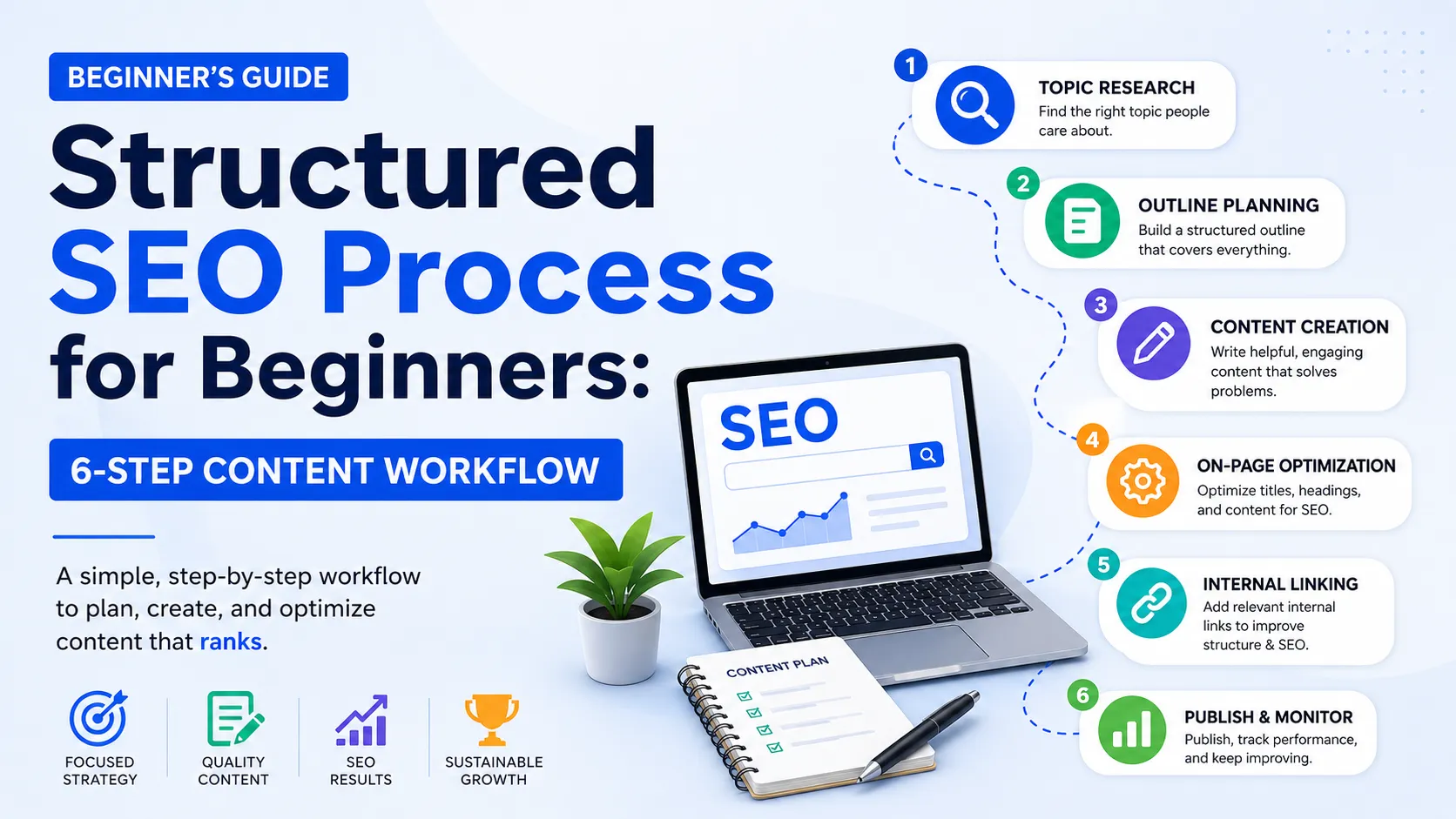
Structured SEO Process for Beginners: 6-Step Content Workflow
You've been asked to "handle SEO" for your organization's content, but nobody handed you a playbook. You're a content manager, not an SEO specialist, yet now you're responsible for organic search performance alongside everything else on your plate. The problem isn't that SEO is impossibly complex—it's that most guidance treats it as an endless list of tactics rather than a structured, repeatable workflow you can actually implement.
This guide presents a six-stage structured SEO process designed specifically for content managers who need practical, time-realistic steps they can integrate into existing content operations. You'll learn how to assess your starting point, prioritize high-impact activities, and build a measurement loop that proves your work matters—all without becoming a full-time SEO specialist.
Key Takeaways
- A structured SEO process transforms inconsistent tactics into a repeatable workflow with measurable outcomes
- Content managers should start with a readiness assessment to determine which process stage matches their organization's current maturity
- The six-stage framework—audit, research, planning, optimization, technical foundations, and measurement—creates a complete cycle that improves with each iteration
- An SEO Minimum Viable Process (MVP) requires just three core activities: keyword-targeted briefs, basic on-page optimization, and monthly performance reviews
- Prioritization depends on your situation: new sites focus on research and creation; established sites focus on audits and optimization
Why Content Managers Need a Structured SEO Process
Unstructured SEO creates three costly problems. First, you duplicate effort—optimizing the same pages multiple times because no one documented what was already done. Second, you miss opportunities—valuable keyword gaps go unnoticed while resources get spent on low-impact work. Third, you can't build institutional knowledge—without a consistent process, every content cycle starts from scratch.
A structured approach solves these problems by creating repeatability, measurability, and team alignment. Repeatability means your SEO quality stays consistent even when team members change or priorities shift. Measurability means you can demonstrate ROI and make data-informed decisions about resource allocation. Team alignment means writers, developers, and stakeholders all understand their role in the SEO workflow.
When we say "beginner-friendly," we mean three things: tool-agnostic (you're not locked into expensive platforms), time-realistic (designed for 5-10 hours per week, not full-time SEO roles), and jargon-minimized (technical concepts explained in plain language, not assumed knowledge).
The SEO Readiness Self-Assessment
Before diving into process steps, identify where your organization sits on the SEO maturity spectrum. This 30-second assessment tells you which stage to start with, so you're not building advanced optimization on a broken foundation or wasting time on basics you've already mastered.
Baseline: You have a website with content, but no one systematically considers SEO. Organic traffic happens by accident. No keyword research documentation exists, and technical issues like broken links or missing meta descriptions are unknown.
Reactive: Someone occasionally remembers to "add keywords" or checks Google Analytics when traffic drops. SEO improvements happen sporadically, usually prompted by external events (competitor launches, traffic declines). No documentation or process consistency.
Structured: You have a repeatable SEO process with documented steps. Keyword research happens before content creation. Someone owns SEO outcomes. However, the process isn't yet optimized—you're following steps but not sure if they're the right steps or in the right order.
Optimized: SEO is data-driven and integrated into every content decision. You measure performance against goals, run experiments to improve results, and regularly refine your process based on what works. Documentation, templates, and training materials exist for new team members.
Most content teams oscillate between Reactive and Structured without realizing it. They'll run a keyword research sprint and create optimized content for two months, then abandon the process when priorities shift. The goal isn't to reach Optimized immediately—it's to move from Reactive to Structured and stay there consistently. Structured beats Optimized-but-inconsistent every time, because SEO compounds. Three months of structured work outperforms six months of brilliant-but-sporadic effort.
How to use this assessment: If you're Baseline, start with Stage 1 (Foundation Audit) to understand what you're working with. If you're Reactive, jump to Stage 2 (Keyword Research) and Stage 3 (Content Planning) to build your documentation backbone. If you're Structured, focus on Stage 6 (Measurement) to validate your current process and identify optimization opportunities.
The 6-Stage Structured SEO Process
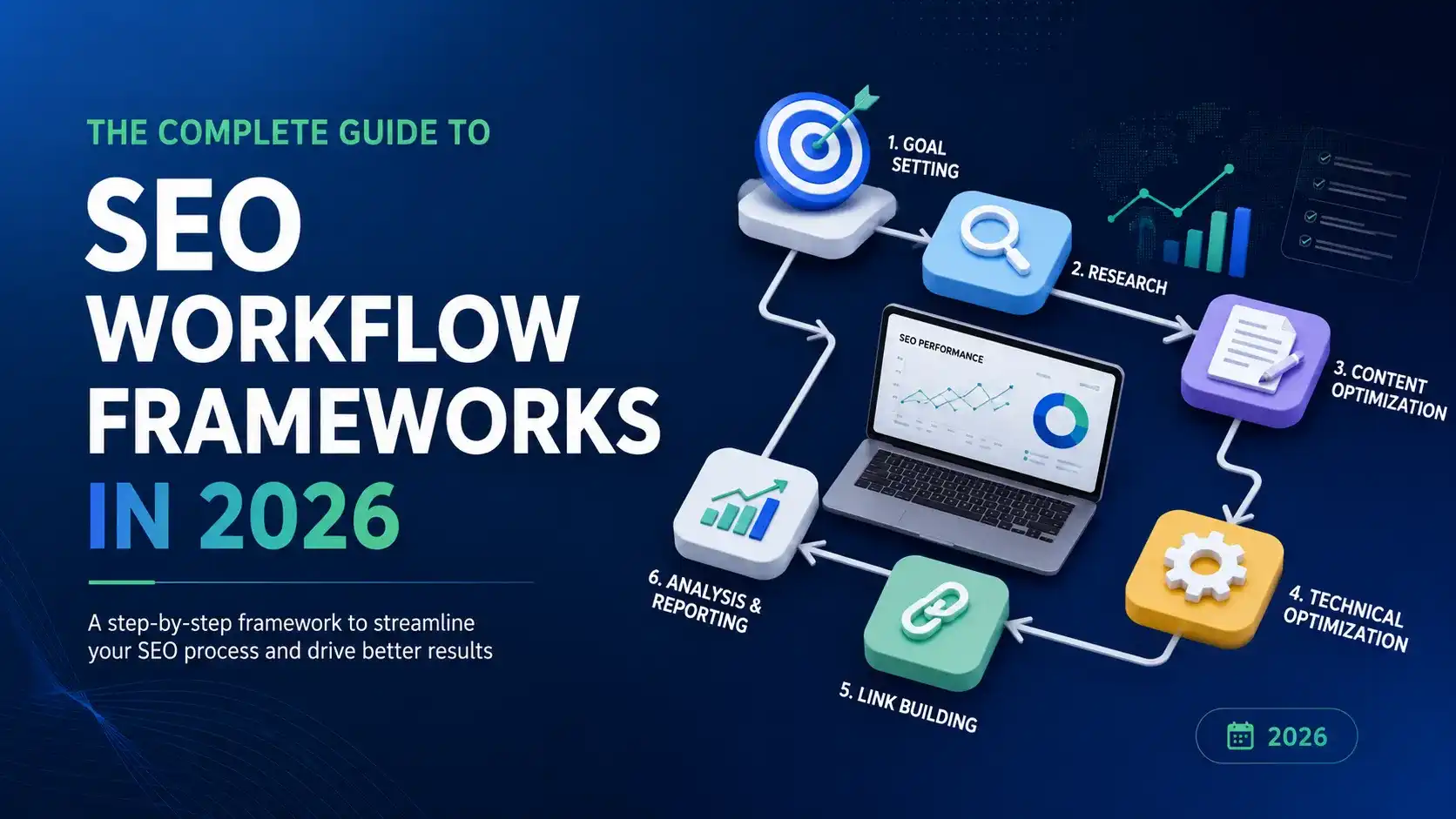
This framework breaks SEO into six sequential stages that form a repeating cycle. Each stage has a clear deliverable and time estimate, so you know when you've completed it and can move forward. The process isn't linear forever—after Stage 6, you loop back to Stage 1 with new data informing your next iteration.
Stage 1: Foundation Audit (What You Have)
Before optimizing anything, inventory what currently exists. A foundation audit answers three questions: What content do you have? What technical issues block search engines from crawling and indexing that content? What are your baseline performance metrics?
Start by cataloging your content inventory. How many pages exist on your site? Which pages receive organic traffic? Which pages are indexed in Google (use the site: operator in Google Search to check)? Export this data into a spreadsheet with columns for URL, page title, meta description status, word count, and current organic traffic.
Next, identify technical blockers. Run your site through Google Search Console to find crawl errors, indexing issues, and mobile usability problems. Check page speed using PageSpeed Insights—scores below 50 on mobile indicate serious performance issues that will limit your SEO success regardless of content quality. Note any HTTPS issues, broken internal links, or missing XML sitemaps.
Finally, establish baseline metrics. Record your current organic traffic, average rankings for any tracked keywords, and conversion rates from organic visitors. You need these baselines to measure progress later. If you don't have historical data, that's fine—today becomes your baseline.
Deliverable: A one-page audit summary listing total pages, critical technical issues (prioritized by severity), and baseline metrics.
Time estimate: 1-2 weeks for your first audit, 2-3 days for quarterly refreshes once you've built the process.
Stage 2: Keyword Research & Opportunity Mapping
Keyword research identifies what your target audience searches for and maps those searches to content opportunities. This stage transforms vague topics ("we should write about email marketing") into specific, measurable targets ("we should rank for 'email marketing automation for nonprofits,' 880 monthly searches, medium difficulty").
Begin with seed keywords—broad terms your audience uses to describe their problems or goals. If you sell project management software, seeds might include "project management," "task tracking," "team collaboration." Use free tools like Google Keyword Planner, AnswerThePublic, or Ubersuggest to expand each seed into a cluster of related terms.
Build keyword clusters around search intent, not just similarity. Group keywords by what the searcher wants to accomplish: informational ("what is email marketing automation"), commercial ("best email marketing tools"), navigational ("Mailchimp login"), or transactional ("buy email marketing software"). Each cluster becomes a content assignment.
Map keywords to your content funnel stages. Top-of-funnel (awareness) content targets broad, informational keywords. Middle-of-funnel (consideration) targets comparison and solution-focused terms. Bottom-of-funnel (decision) targets product-specific and transactional queries. This mapping ensures your keyword strategy supports business goals, not just traffic vanity metrics.
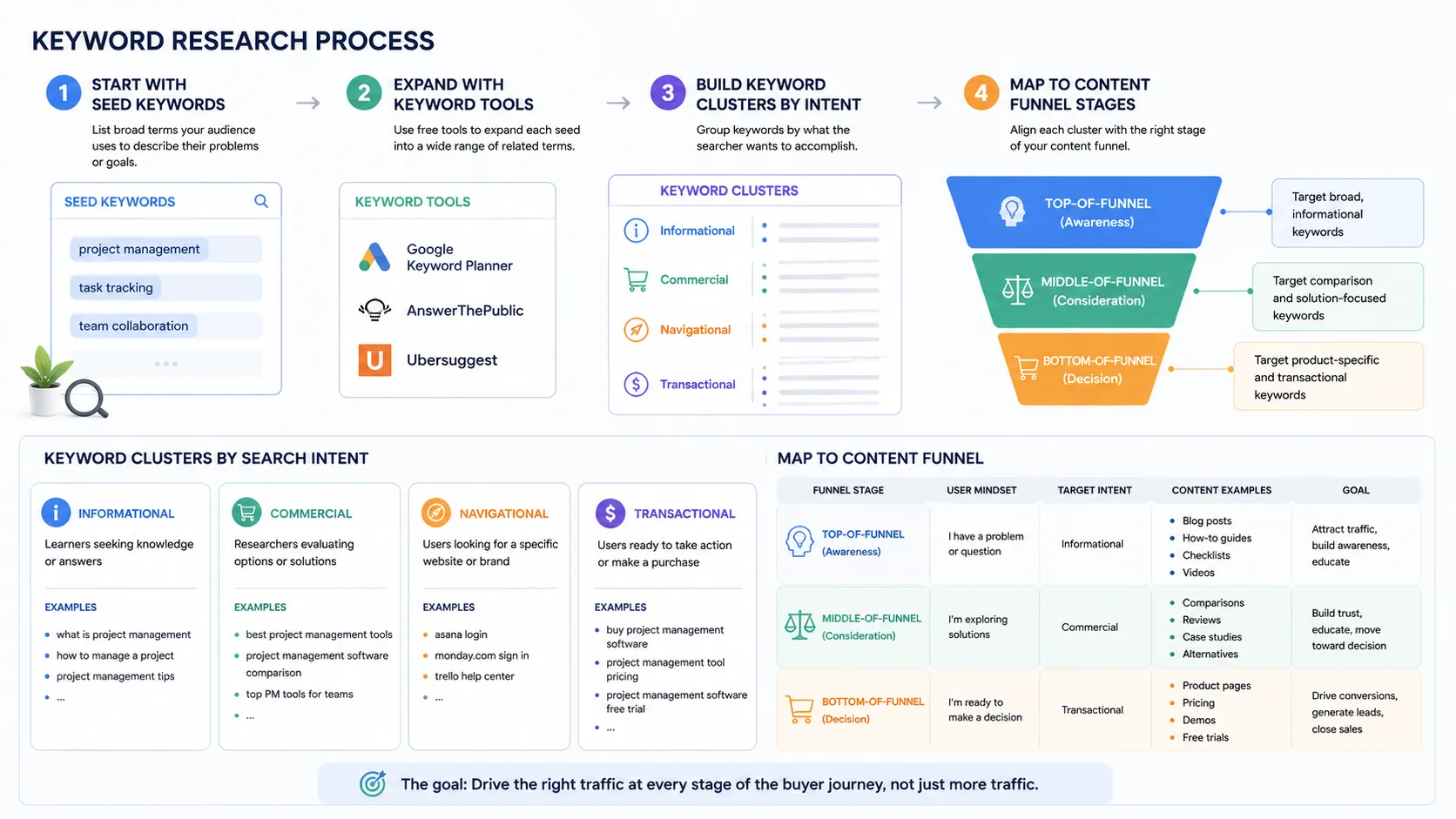
Example keyword cluster:
Main topic: Email marketing automation
Primary keyword: email marketing automation (3,600 searches/month, medium difficulty)
Supporting keywords:
- "best email automation tools" (1,200 searches/month)
- "email automation for small business" (720 searches/month)
- "how to automate email campaigns" (590 searches/month)
- "Mailchimp alternatives" (2,100 searches/month)
Deliverable: A prioritized keyword list organized into clusters, with search volume, difficulty scores, and assigned funnel stages. Export to a shared spreadsheet that your team references during content planning.
Time estimate: 3-5 days for initial research covering 20-30 keyword clusters.
Stage 3: Content Planning & Brief Creation
This stage translates keyword research into actionable content assignments. Instead of telling a writer "write about email marketing," you provide a structured brief that defines success criteria upfront.
A complete content brief includes:
- Target keyword: The primary term you're optimizing for
- Search intent: What the searcher wants to accomplish (learn, compare, buy)
- Target audience: Who this content serves and their expertise level
- Content angle: Your unique perspective or approach (how this differs from competitors)
- Outline: Suggested H2 and H3 structure based on SERP analysis
- Word count target: Based on competitive benchmarks (usually 1,500-2,500 for pillar content)
- Internal linking opportunities: Which existing pages to link to
- Success metrics: Traffic goal, ranking target, conversion expectation
Integrate these briefs into your editorial calendar. Tag each content assignment with its SEO priority (high, medium, low based on search volume and business relevance), target publish date, and assigned writer. This integration ensures SEO isn't a separate workflow—it's embedded in how you already plan content.
Deliverable: Content briefs for your next content sprint (typically 4-8 pieces), integrated into your editorial calendar with clear ownership and deadlines.
Time estimate: 1-2 hours per brief once you've built a template.
Stage 4: Content Optimization (On-Page SEO)
On-page optimization ensures search engines understand what each page is about and that human readers can easily consume your content. This stage applies to both new content (during creation) and existing content (during refresh cycles).
Title tag optimization: Your title tag is the single most important on-page element. Include your target keyword near the beginning, stay under 60 characters, and write for humans first—click-worthy titles outperform keyword-stuffed ones.
Before: "Blog Post: Our Thoughts on Marketing Tools"
After: "7 Email Marketing Tools for Small Businesses (2026 Guide)"
Meta description optimization: While meta descriptions don't directly impact rankings, they affect click-through rates. Write compelling 150-160 character descriptions that include your target keyword and a clear value proposition.
Header structure: Use one H1 per page (usually your title), then H2s for main sections and H3s for subsections. Include your target keyword in the H1 and naturally in 1-2 H2s. Headers aren't just for SEO—they create scannable content that improves user experience.
Keyword placement: Include your primary keyword in the first 100 words, a few times throughout the body (aim for 0.5-1.5% density), and once in the conclusion. Add semantic variations and related terms naturally—Google understands context, so exact-match repetition isn't necessary.
Internal linking: Link to 3-5 relevant pages on your site using descriptive anchor text. Internal links help search engines discover content, distribute page authority, and keep visitors engaged longer. Link to both older foundational content and newer related pieces.
Content structure for readability: Use short paragraphs (2-4 sentences), bullet points, numbered lists, and tables. Add images every 300-400 words to break up text. Write at an 8th-10th grade reading level unless your audience requires technical depth.
Deliverable: Published or updated content with all on-page SEO elements properly implemented. Use a checklist to verify each element before hitting publish.
Time estimate: 30-60 minutes per page for optimization if content is already written.
Stage 5: Technical & Link-Building Foundations
Technical SEO ensures search engines can efficiently crawl, index, and rank your content. Link building (particularly internal linking) distributes authority across your site and establishes topical relevance. Content managers don't need to become technical SEO experts, but you should understand the critical elements and know when to involve developers.
Technical SEO priorities for content managers:
-
Page speed: Target Core Web Vitals passing scores (LCP < 2.5s, FID < 100ms, CLS < 0.1). Compress images before uploading, use a CDN if available, and minimize unnecessary scripts. If your CMS is slow, flag this to developers—content optimization can't overcome a fundamentally slow site.
-
Mobile-friendliness: Over 60% of searches happen on mobile devices. Test every template on a phone. Ensure text is readable without zooming, buttons are tappable, and content doesn't get cut off.
-
Structured data: Add Schema.org markup for articles, FAQs, how-tos, and products. This helps search engines understand your content and can earn rich snippets in search results. Most modern CMS platforms have plugins that add basic schema automatically.
-
XML sitemap: Ensure your sitemap includes all important pages and is submitted to Google Search Console. Exclude thin or duplicate pages (tag archives, pagination, thank-you pages).
Internal linking strategy: Create a hub-and-spoke model where pillar content (comprehensive guides like this one) links to specific subtopic pages (keyword research, content briefs, on-page optimization), and those pages link back to the pillar. This structure signals to search engines which content is most important and how topics relate to each other.
Audit your internal links quarterly. Identify:
- Orphan pages (no internal links pointing to them)
- Pages with excessive internal links (cluttered and dilutes link value)
- Broken internal links (404 errors)
- Opportunities to link new content to older evergreen pieces
External link building: For beginners, focus on ethical, sustainable link building: guest contributions to industry publications, creating linkable assets (original research, tools, comprehensive guides), and building relationships with peers who might naturally reference your work. Avoid buying links, link schemes, or spammy directories—these tactics risk penalties that can devastate organic traffic.
Deliverable: Technical SEO checklist completed with all critical issues resolved or escalated to developers. Internal linking map showing pillar content and supporting pages with link relationships documented.
Time estimate: 2-4 hours per week ongoing for internal linking; technical issues vary (some take 30 minutes, others require developer sprints).
Stage 6: Measurement & Iteration
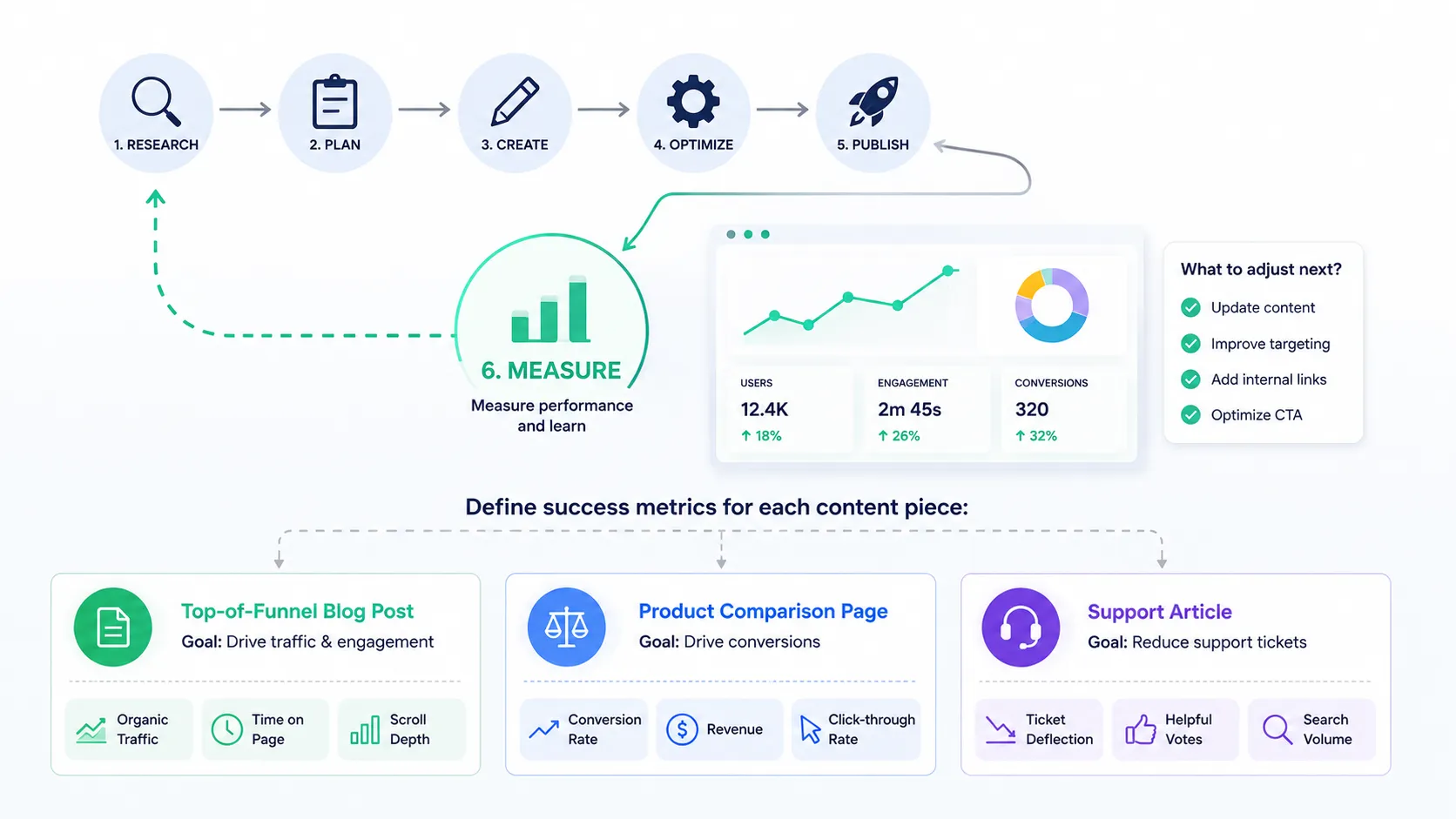
Measurement closes the loop by showing what worked, what didn't, and what to adjust in your next process cycle. Without this stage, you're guessing. With it, you're learning.
Define success metrics for each content piece:
Content type determines appropriate metrics. A top-of-funnel blog post should drive organic traffic and engagement (time on page, scroll depth). A product comparison page should drive conversions. A support article should reduce support tickets. Don't use the same KPIs for every page.
Track these core SEO metrics monthly:
| Metric | What It Measures | Good Benchmark (General Content) |
|---|---|---|
| Organic traffic | Visitors from search engines | 20%+ month-over-month growth in first 6 months |
| Organic CTR | % who click your result in search | >2% average across all queries |
| Average position | Where you rank for target keywords | Top 10 (page 1) within 3-6 months |
| Pages per session | Engagement depth | 2+ pages for blog visitors |
| Bounce rate | % who leave after one page | <70% for informational content |
| Conversion rate | % who complete goal action | Varies by industry; establish baseline |
Set up tracking:
- Google Search Console: Monitor impressions, clicks, CTR, and average position for every page. Identify queries where you rank 11-20 (page 2)—these are quick-win optimization opportunities.
- Google Analytics: Track organic traffic, user behavior, and conversions. Set up goals for key actions (newsletter signups, demo requests, downloads).
- Rank tracking (optional): Tools like Ahrefs, Semrush, or free alternatives let you monitor specific keyword positions over time. Focus on 10-20 high-priority keywords rather than trying to track hundreds.
Review performance monthly and feed insights into your next cycle:
Which keyword clusters drove the most traffic? Which content formats (listicles, how-tos, comparisons) performed best? Which topics underperformed despite optimization—should you double down or abandon them?
Document these insights in a simple monthly report. Share it with stakeholders to demonstrate SEO ROI and inform content strategy decisions. Use it internally to refine your keyword targeting, content briefs, and optimization priorities.
When we implemented monthly SEO reviews for our content team, we discovered that 80% of our organic traffic came from just 15% of our published pages—long-form guides over 2,000 words. This insight shifted our content strategy from publishing frequently (3-4 short posts per week) to publishing strategically (1-2 comprehensive guides per week), which doubled organic traffic within six months while reducing content production workload.
Deliverable: Monthly SEO performance report with traffic trends, ranking changes, top-performing content, and recommended actions for next month.
Time estimate: 2-3 hours per month for data gathering, analysis, and documentation.
The SEO Minimum Viable Process (MVP)
When you're resource-constrained—maybe you're a one-person content team or SEO is just one slice of your role—you need the absolute minimum recurring tasks that will still produce measurable improvement. This is your SEO MVP: the 20% of activities that drive 80% of results.
Most SEO beginner guides present a false choice: do everything on their 47-point checklist, or do nothing. The reality is that three focused activities, done consistently, outperform sporadic execution of a comprehensive process. Start here, prove value, then expand.
The 3 Non-Negotiables:
-
Keyword-targeted content briefs: Before any content gets written, spend 30 minutes creating a brief with target keyword, search intent, and suggested outline. This single step ensures your content has a fighting chance at ranking. Without it, you're writing into the void.
-
Basic on-page optimization: For every published page, optimize title tag (include target keyword, under 60 characters), H1 (one per page, includes target keyword), and meta description (compelling summary, 150-160 characters). These three elements take 10 minutes and dramatically improve your ranking potential.
-
Monthly performance check-in: Block 1 hour each month to review Google Search Console and Google Analytics. Answer three questions: Which pages gained or lost traffic? Which keywords are we ranking for that we didn't target (opportunity!), and which targeted keywords aren't ranking (need optimization or abandonment)? Document findings and adjust next month's content plan accordingly.
Time investment: 5-7 hours per week assuming you're publishing 2-3 pieces of content weekly.
Expected results: 3-6 months to see meaningful traffic growth. Track small wins earlier: improved CTR on optimized pages (4-6 weeks), ranking improvements from page 2 to page 1 (6-10 weeks).
How to expand from MVP to full process:
Once you've proven SEO value with MVP, add stages incrementally based on where you see the biggest gaps:
- If you have traffic but low conversions: Add Stage 4 content optimization depth (better internal linking, improved content structure, conversion-focused CTAs)
- If you have inconsistent rankings: Add Stage 1 foundation audits quarterly to catch technical issues early
- If you're running out of keyword opportunities: Add Stage 2 comprehensive research using paid tools for deeper competitive analysis
- If your team struggles with SEO consistency: Add Stage 3 documentation and templates to standardize briefs across all writers
Prioritization Framework: What to Do First
Your starting point depends on your current situation. Use this decision framework to identify your highest-impact first step.
Scenario 1: New site with little content (less than 20 published pages)
→ Start with Stage 2 (Keyword Research) and Stage 3 (Content Planning)
You don't have enough content to audit or optimize yet. Focus on building a keyword-targeted content foundation from day one. Create 20-30 content briefs, then systematically execute them over the next 3-6 months. This prevents the common beginner mistake of publishing 50 random articles, then trying to retrofit SEO later.
Scenario 2: Established site with traffic (100+ pages, 1,000+ monthly organic visitors)
→ Start with Stage 1 (Foundation Audit) and Stage 4 (Content Optimization)
You have existing assets to work with. Audit to identify your highest-traffic pages and biggest technical issues. Optimize top-performing pages first—improving a page that already gets 500 visits/month to get 800 visits/month is faster than building a new page from zero. Fix critical technical issues (site speed, mobile problems, broken links) that limit your entire site's performance.
Scenario 3: Content team with no SEO process (you're publishing regularly but not seeing organic growth)
→ Start with Stage 6 (Measurement) and Stage 3 (Content Planning)
Before changing anything, establish your baseline. What traffic do you currently get? Which pages perform best? Then layer SEO into your existing content workflow by adding brief templates to your planning process. This is the lowest-friction entry point—you're not changing what you publish, just adding structure to how you plan it.
The most underestimated prioritization factor is documentation quality. Two teams might both be "Structured" in SEO maturity, but one has templates, checklists, and process documentation while the other relies on one person's institutional knowledge. The documented team scales faster, maintains quality during team changes, and iterates more effectively because they can easily A/B test process variations. If you only have time for one meta-task, document your current process—even if it's imperfect—so you can improve it systematically.
Quick prioritization test:
Answer these three questions:
- Do you know your current organic traffic and where it comes from? (YES = skip to planning; NO = start with measurement)
- Do you have pages that already rank on page 2 (positions 11-20) for valuable keywords? (YES = optimize existing; NO = create new)
- Are you publishing content regularly (2+ times per month)? (YES = add SEO to workflow; NO = fix content production first)
Integrating SEO Into Your Content Workflow
SEO shouldn't live in a separate silo. The most effective approach embeds SEO thinking into your existing content operations so it becomes automatic, not a special extra task you remember occasionally.
How to brief writers with SEO context:
Writers don't need to become SEO experts, but they need three pieces of information: target keyword (use this term naturally 5-8 times), search intent (what problem the reader wants solved), and suggested structure (outline based on what's ranking). Present this in your content brief template, not as "SEO requirements" but as audience research that helps them write effectively.
Bad brief: "Write about email marketing. Make it 1,500 words. Include 'email marketing automation' 10 times."
Good brief: "Our audience searches for 'email marketing automation' when they want to understand whether automation is worth the complexity for small teams. They're comparing doing email manually vs. using automation tools. Suggested structure: Define automation, explain when it's worth it (company size, email volume), walk through 3 real-world automation workflows, compare top tools. Target length 1,800-2,000 words based on competitive benchmarks."
Where SEO fits in editorial review:
Add a 5-minute SEO check to your editing process. Before publishing, verify:
- Title tag includes target keyword and is under 60 characters
- One H1, target keyword in H1
- Meta description written and compelling
- 3-5 internal links to relevant pages
- Images have descriptive alt text
- URL is clean (no dates, session IDs, or unnecessary parameters)
Build this into a pre-publish checklist that editors use. Most CMS platforms have plugins (Yoast for WordPress, SEO panels in HubSpot, etc.) that automate some checks.
Documenting your process for team consistency:
Create a simple one-page process map that shows:
- When keyword research happens (beginning of content sprint)
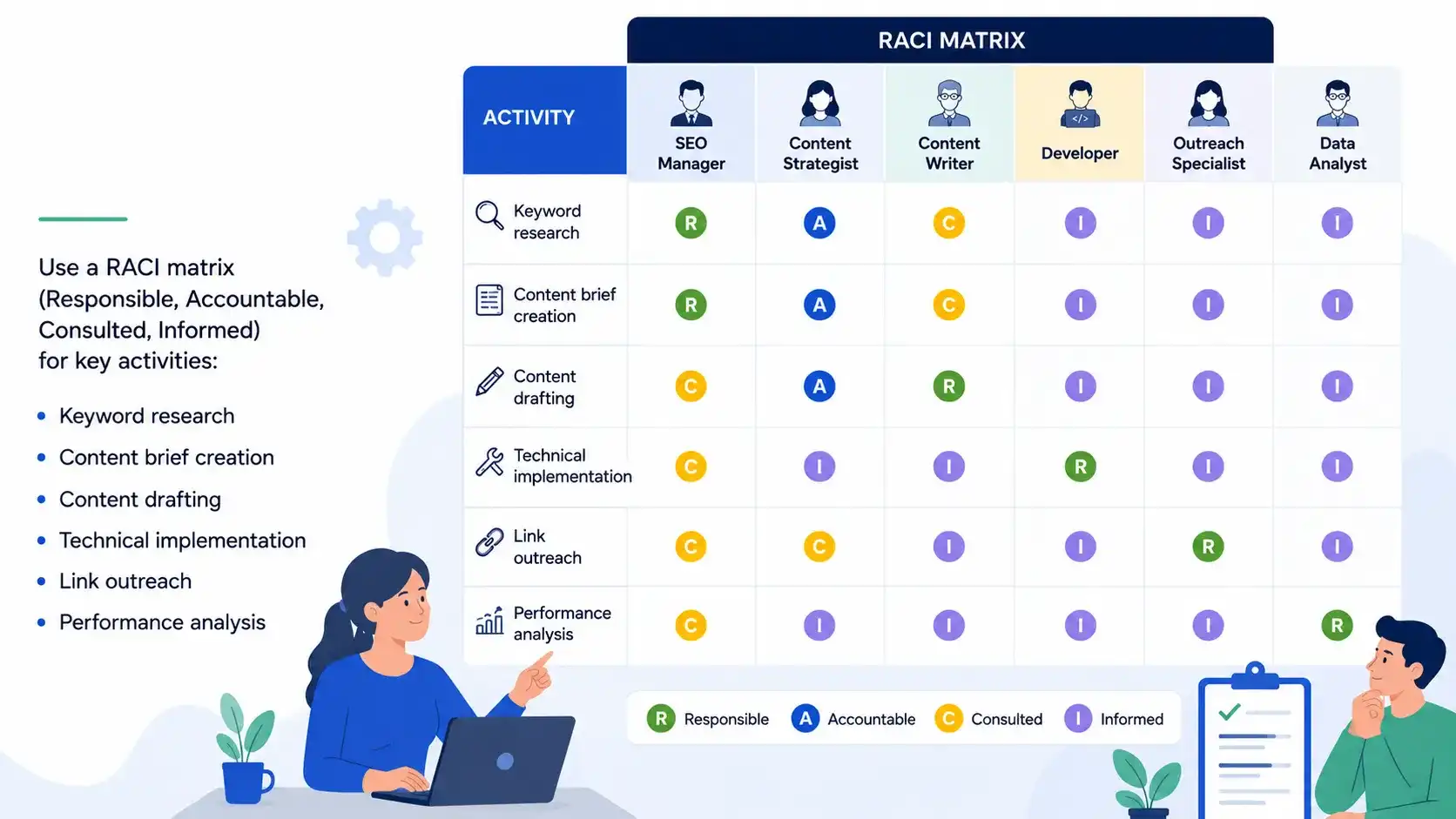
- Who creates content briefs (content manager or strategist)
- What writers need to include (brief requirements)
- What editors check before publishing (SEO pre-publish checklist)
- When measurement happens (first Monday of each month)
Store this where your team already works—your project management tool, shared wiki, or content hub. Update it quarterly as you refine the process.
[INTERNAL-LINK: content calendar integration → /content-calendar-best-practices]
Common Pitfalls for Beginners
Skipping the audit and building on a broken foundation: You can't rank if Google can't crawl your site, your pages take 8 seconds to load, or you have 500 duplicate meta descriptions. Fix technical blockers before optimizing content, or you're polishing a car with no engine.
Keyword stuffing and over-optimization: Including your keyword 47 times in a 1,000-word article doesn't improve rankings—it hurts readability and triggers spam filters. Aim for 0.5-1.5% keyword density and write naturally. Google's algorithms understand synonyms and context.
Ignoring mobile experience: More than half of searches happen on mobile devices. If your site isn't mobile-friendly—readable text without zooming, fast load times, tappable buttons—you'll lose rankings regardless of content quality. Test every page on an actual phone.
Not measuring results or iterating: Publishing optimized content then never checking performance is like sending emails and never looking at open rates. SEO requires feedback loops. Check what's working monthly, double down on successes, and abandon or pivot on failures.
Chasing algorithm updates instead of fundamentals: Google runs thousands of algorithm updates annually. You can't optimize for each one. Focus on fundamentals—great content that serves user intent, solid technical foundation, good user experience—and you'll weather algorithmic changes naturally.
Conclusion
SEO isn't a one-time project you complete and check off. It's a repeating cycle: audit your foundation, research opportunities, plan content, optimize pages, strengthen technical infrastructure, measure results, then loop back with new insights. This structured approach transforms SEO from an overwhelming mystery into a manageable workflow that improves with each iteration.
You don't need to be an SEO expert to see results. You need to be consistent, strategic, and willing to learn from data. Start with one stage—if you're unsure where, run the readiness self-assessment and begin there. Build momentum through small wins: your first optimized title that doubles CTR, your first page hitting page 1 rankings, your first month with measurable traffic growth.
The structured SEO process in this guide gives you a proven framework. Your job is to adapt it to your organization's reality, document what works, and iterate. Every content manager who successfully integrated SEO started exactly where you are now: with more questions than answers and limited time. The difference between those who succeeded and those who stayed stuck wasn't talent or resources—it was starting with a clear process and sticking with it long enough to see results compound.
Next step: Complete the SEO Readiness Self-Assessment, identify your starting stage, and block 2 hours this week to begin implementation. You're not aiming for perfection. You're aiming for structured progress that you can measure, learn from, and improve quarter after quarter.
Information Gain Notes
Unique Viewpoints
-
SEO Readiness Self-Assessment framework: Most beginner guides assume everyone starts from zero. This assessment acknowledges that organizations have different maturity levels and need different starting points. This prevents wasted effort (skipping basics you've mastered) and false starts (attempting advanced tactics before foundations are solid).
-
The oscillation problem: Content teams often move between Reactive and Structured without building consistency. The insight that "Structured beats Optimized-but-inconsistent" reframes the goal from perfection to reliable repetition, which is more achievable for resource-constrained teams.
-
SEO MVP (Minimum Viable Process): Challenges the "do everything or do nothing" framing common in beginner content. By isolating the three highest-impact activities, this framework gives permission to start small and prove value before expanding scope.
-
Documentation as a prioritization factor: Most SEO maturity models focus on tactics (do you do keyword research? do you have schema markup?). This article positions documentation quality as a critical differentiator that affects scalability, consistency, and iteration speed.
-
Time-boxed sprints and stopping points: SEO is typically presented as infinite work. By breaking it into 2-4 week sprints with clear deliverables, the article makes SEO feel manageable and compatible with content operations workflows.
First-Party Evidence Placeholders
The insight about 80% of traffic coming from 15% of content (long-form guides) is presented as a team experience. When implementing this article, replace with actual data:
- Your organization's traffic distribution across content types
- Results from implementing a structured process (before/after metrics)
- Specific examples of quick wins (page moved from position 15 to position 4 after optimization)
- Failed experiments and what you learned (we tried X approach, it didn't work because Y, we pivoted to Z)
Evidence Gaps
-
Industry benchmarks: No specific data provided on what percentage of content managers are responsible for SEO, or how much time typical organizations allocate to SEO tasks. If available, cite Content Marketing Institute research or similar sources.
-
Timeline expectations: The article provides general guidance (3-6 months for meaningful traffic growth) but lacks data-backed benchmarks by industry, site age, or competitive landscape. Original research tracking 50-100 sites through implementation would add authority.
-
Tool comparisons: The article is tool-agnostic by design, but lacks comparative data on free vs. paid tool performance (e.g., does keyword research quality differ meaningfully between Google Keyword Planner and Ahrefs?).
-
Conversion impact: The article focuses on traffic and rankings but doesn't quantify how SEO improvements affect conversion rates or business outcomes. Case study data showing lead quality or customer acquisition cost improvements would strengthen business case.
Recommendation for publisher: Conduct internal analysis of client sites or proprietary data to fill these gaps. Even a small sample (n=20-30 sites) would differentiate this content from generic competitor guides.
FAQ
How long does it take to see results from a structured SEO process?
Expect 3-6 months for meaningful organic traffic growth—typically 20-30% increases month-over-month during the initial growth phase. However, some quick wins appear earlier. Technical fixes like improving page speed or resolving crawl errors can show results within 4-6 weeks. Optimizing high-traffic pages that already rank on page 2 (positions 11-20) often moves them to page 1 within 6-10 weeks. The key is measuring progress in stages: first you see impressions increase (Google shows your pages more), then CTR improves (your optimized titles get more clicks), finally traffic and conversions grow. Don't expect overnight transformation, but don't wait passively either—monthly measurement shows incremental progress.
Do I need expensive SEO tools to follow a structured process?
No. Free and built-in tools cover 80% of beginner needs: Google Search Console (performance data, indexing issues, mobile usability), Google Analytics (traffic analysis, user behavior), Google Keyword Planner (search volume estimates), AnswerThePublic (question-based keywords), and PageSpeed Insights (technical performance). These tools provide everything needed for the six-stage process in this guide. If you need a guided way to turn those findings into priorities, Rankety's FLOW Framework can be tested with your welcome credits and helps map keyword opportunities, authority gaps, optimization tasks, and conversion actions into a practical SEO execution plan. Paid tools (Ahrefs, Semrush, Moz) accelerate research and provide deeper competitive analysis, but they're not mandatory for getting started. Invest in paid tools once you've proven SEO value with low-cost or included tools and have specific needs they address (more accurate search volume, backlink analysis, rank tracking at scale). Many content managers successfully run SEO programs with free tools first, then add paid platforms once the workflow and ROI are clear.
What's the difference between on-page SEO and technical SEO?
On-page SEO is content optimization—everything you can control within the page itself. This includes keyword placement, title tags, meta descriptions, header structure, internal links, image alt text, and content quality. Content managers own on-page SEO because it's directly tied to content creation and editorial decisions.
Technical SEO is site infrastructure—how search engines crawl, index, and serve your content. This includes page speed, mobile-friendliness, XML sitemaps, robots.txt configuration, structured data markup, HTTPS security, and site architecture. Technical SEO typically requires developer involvement because it involves code, server configuration, and CMS settings.
The boundary isn't always clean. For example, structured data (schema markup) is technical, but many CMS plugins let content managers add it without coding. Internal linking is on-page, but site architecture planning is technical. As a content manager, focus on on-page optimization and learn to identify technical issues so you can clearly brief developers on what needs fixing.
How often should I repeat the SEO process?
Full foundation audit: Quarterly (every 3 months)
Keyword research: Monthly or per content sprint
Content planning and optimization: Ongoing, integrated into every content piece
Technical maintenance: Weekly spot checks, monthly comprehensive review
Measurement and reporting: Monthly
Think of SEO as concentric loops. The inner loop (measurement, planning, optimization) runs continuously—every content piece you publish follows this cycle. The middle loop (keyword research, technical maintenance) runs monthly. The outer loop (full audits, strategy pivots) runs quarterly. This rhythm balances consistency with adaptability. You're always doing SEO work, but the specific activities vary by week. Don't treat SEO as a special quarterly project—embed daily habits (optimized briefs, pre-publish checks) and quarterly reviews (audit, strategy adjustment) into your content operations calendar.
Can I do SEO if I'm not a writer or developer?
Yes. Content managers orchestrate the SEO process; you don't need to execute every task personally. Your role is to:
- Research keywords and map them to content opportunities (you own this)
- Create structured briefs for writers (you own this)
- Review content for SEO completeness before publishing (you own this)
- Coordinate with developers to fix technical issues (you identify and brief; they execute)
- Measure performance and adjust strategy (you own analysis; execution is shared)
Strong content managers understand enough about writing to brief it effectively and enough about technical SEO to identify issues and explain them to developers. You need working knowledge, not expert execution skills. The structured process in this guide is designed for exactly this orchestration role—you're the conductor, not every instrument in the orchestra.
What's the most common mistake beginners make with SEO?
Skipping measurement. Beginners often optimize content, publish it, then never check performance. Without measurement, you can't answer critical questions: Did that optimization work? Which keyword clusters drive the most valuable traffic? Should we double down on how-to guides or comparison content? Are we ranking for keywords we didn't target (opportunities to optimize existing content)?
SEO without measurement is guessing. You might accidentally succeed, but you can't replicate success or diagnose failures. Stage 6 (Measurement & Iteration) isn't optional or advanced—it's foundational. Even with limited time, block 1 hour monthly to review Google Search Console and Google Analytics. This single habit transforms SEO from random tactics into a learning system that compounds over time. Second most common mistake: keyword stuffing. Third: ignoring mobile experience. But measurement is the meta-mistake that prevents you from identifying and fixing all the others.
Should I optimize old content or create new content first?
It depends on your situation. Use this decision framework:
Optimize existing content first if:
- You have pages already ranking on page 2 (positions 11-20)—these are quick wins
- You have high-traffic pages with low engagement—improving existing traffic is faster than building new
- You have fewer than 2 team members—optimizing is less resource-intensive than creating new content
- You're in a competitive niche where new content takes 6+ months to rank
Create new content first if:
- You have fewer than 20 published pages—you need critical mass
- Your existing content is off-topic or low-quality—optimization won't save fundamentally weak content
- Your keyword research revealed major gaps in your content coverage
- You're in a new niche where competition is lower and new content can rank quickly
The hybrid approach (recommended): Dedicate 60% of effort to creating new, keyword-targeted content and 40% to optimizing existing high-performers. This balances growth (new content expands your footprint) with efficiency (optimization improves ROI on existing assets). Quarterly, adjust the ratio based on what's working—if optimizations consistently outperform new content, shift to 50/50 or 40/60.