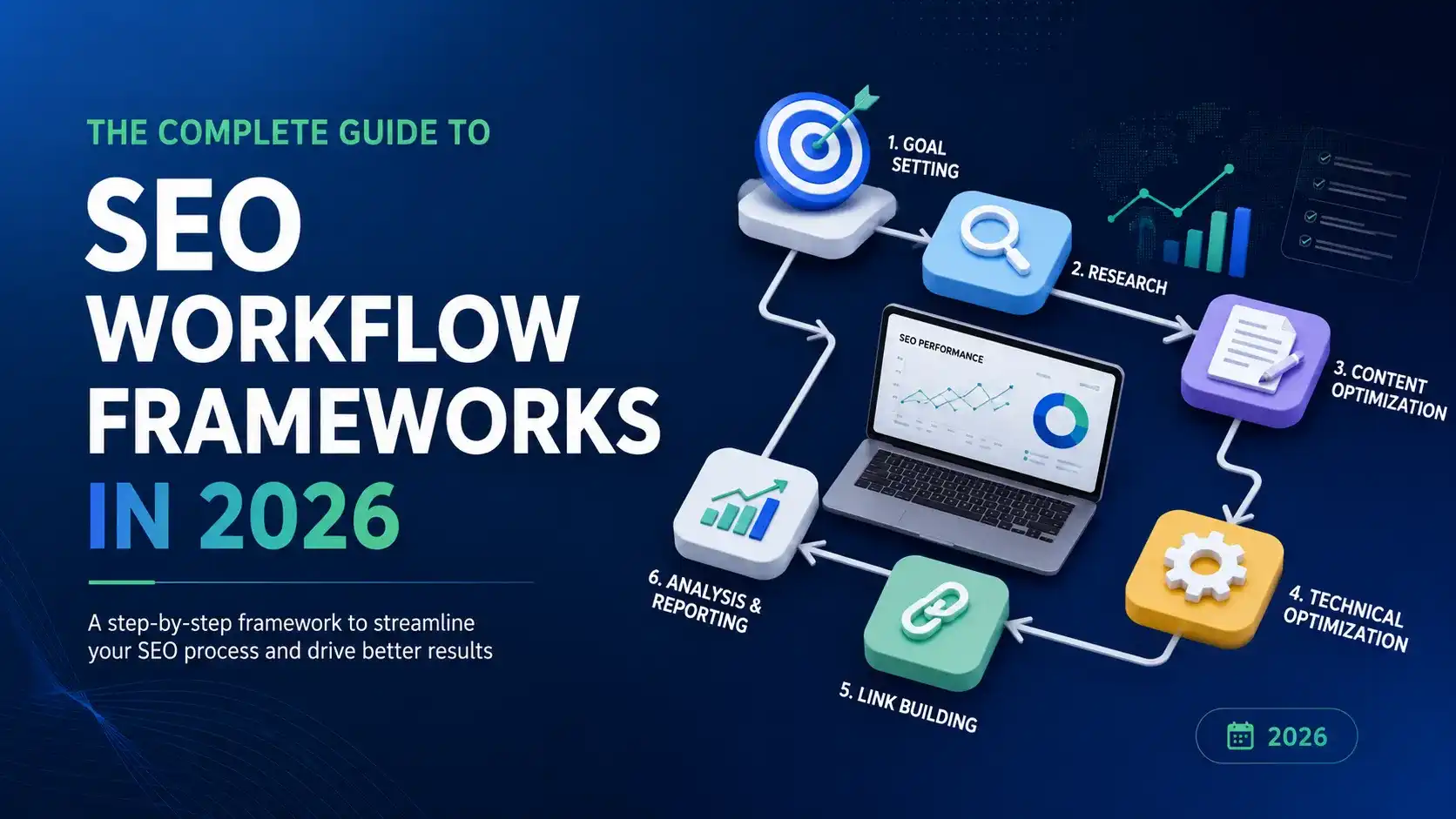
The Complete Guide to SEO Workflow Frameworks in 2026
Introduction
The global SEO services market reached $83.98 billion in 2026 and is projected to grow to $148.86 billion by 2031 (Mordor Intelligence, 2026). Yet despite this massive investment, 86% of employees cite lack of collaboration or ineffective communication as the main cause of workplace failures (Salesforce via Agiled, 2026). The disconnect? Most SEO teams lack structured workflow frameworks.
An SEO workflow framework is a systematic process that defines how your team plans, executes, and measures search optimization activities. Unlike ad-hoc approaches, frameworks provide repeatable structures that improve consistency, reduce errors, and scale with team growth.
In this comprehensive guide, you'll learn how to design, implement, and optimize SEO workflow frameworks that cut production time by 60-80%, boost team productivity by 30%, and deliver measurable ROI improvements. We'll cover everything from task allocation models and automation strategies to hybrid team collaboration patterns and efficiency metrics.
This guide synthesizes frameworks tested across enterprise and agency implementations, combining 2026 industry research with practical insights from teams managing both in-house and distributed workflows.Whether you're a solo SEO consultant standardizing your process or a marketing director coordinating distributed teams, you'll walk away with actionable frameworks you can implement today.
Key Takeaways
- SEO professionals dedicate an average of 26 hours per week to optimization tasks (Search Engine Journal via ROI Amplified, 2025), making structured workflows essential for team productivity
- AI-powered workflow automation cuts content production time by 60-80% while reducing costs by 85% (Digital Applied, Contadu, 2024-2025)
- Teams using collaboration tools in their SEO workflows report 30% higher productivity (McKinsey via Agiled, 2026)
- The global SEO services market reached $83.98 billion in 2026, projected to hit $148.86B by 2031 (Mordor Intelligence, 2026)
What Is an SEO Workflow Framework?
An SEO workflow framework is a documented system of processes, roles, and tools that guides how your team executes search optimization activities from planning through measurement.
Key Components:
- Process stages: Research → Planning → Execution → Analysis → Iteration
- Role definitions: Who owns keyword research, content creation, technical audits, link building
- Tool stack: The platforms your team uses for each workflow stage
- Quality gates: Checkpoints that ensure standards are met before moving forward
- Timeline parameters: How long each stage should take and when deliverables are due
- Communication protocols: How team members share updates, flag blockers, and request reviews
Unlike informal approaches where SEO tasks happen reactively, frameworks provide structure. When a new project starts, everyone knows their role, the sequence of activities, and success criteria.
What SEO workflows are NOT:
- One-time project plans (frameworks are reusable across projects)
- Tool-specific processes (frameworks are tool-agnostic, though tools enable them)
- Rigid bureaucracy (effective frameworks adapt to project scope)
The framework concept evolved from software development methodologies (Agile, Kanban) applied to marketing operations. Early SEO was tactical—keyword stuffing, link directories—but as algorithms matured, the discipline became more strategic and team-based. By 2026, 87% of SEO companies operate as fully hybrid teams (Gitnux, 2026), making workflow frameworks essential for distributed collaboration.
Why SEO Workflows Matter in 2026
Teams using collaboration tools within structured workflows report being 30% more productive than those using ad-hoc processes (McKinsey via Agiled, 2026). When SEO professionals average 26 hours per week on optimization tasks (Search Engine Journal via ROI Amplified, 2025), that 30% gain translates to nearly 8 hours of reclaimed time weekly.
Industry trends driving workflow adoption:
In 2026, content workflow automation delivers an 85% reduction in production costs (Contadu, June 2024), while AI-assisted workflows cut production time by 60-80% (Digital Applied, 2025). These efficiency gains are not hypothetical—64% of marketers already cite increased productivity as their top metric for measuring AI tool effectiveness (HubSpot via SeoProfy, June 2026).
Consequences of ignoring workflow structure:
- Task bottlenecks when dependencies are unclear
- Duplicated effort when team members work in silos
- Quality inconsistencies without standardized processes
- Missed opportunities because audits happen reactively instead of quarterly (Seomator, 2026 recommends quarterly as standard)
Opportunity framing:
Organizations with documented SEO workflows see measurable ROI improvements. Thought leadership SEO delivers a median 748% ROI with 9-month breakeven, while technical SEO achieves 117% ROI with 6-month breakeven (SeoProfy, 2026). The difference often comes down to execution consistency—frameworks ensure best practices are followed project after project.
Core Components of an Effective SEO Workflow
Every high-performing SEO workflow contains six foundational components: intake, research, planning, execution, quality assurance, and measurement.
1. Intake & Prioritization
Define how SEO opportunities enter your workflow. Common triggers:
- Quarterly audit findings
- New product launches requiring content
- Algorithm updates necessitating technical changes
- Competitive intelligence revealing gaps
Priority framework: Use ICE scoring (Impact × Confidence × Ease) to rank opportunities objectively.
2. Research Phase
Allocate 25% of total project time here (Digidop, 2025). Research includes:
- Keyword research and analysis: 8-10 hours ongoing average (seoClarity, 2024-2025)
- SERP analysis to understand ranking factors
- Content gap identification through competitor mapping
- Technical audit using crawl tools
3. Planning & Resource Allocation
Document who does what, by when. Effective plans specify:
- Content briefs with target keywords, structure, word count
- Technical implementation requirements
- Link building targets and outreach lists
- Timeline with milestones
4. Execution
This is where content gets written (35% of time allocation per Digidop), technical changes deployed, and outreach conducted. Structured execution includes:
- Draft → review → revise cycles with clear ownership
- Version control for content and code changes
- Progress tracking visible to all stakeholders

5. Quality Assurance Gates
Before publishing, workflows need checkpoints:
- Editorial review for E-E-A-T signals and accuracy
- Technical QA for page speed, mobile-friendliness, schema
- SEO checklist verification (title tags, meta descriptions, internal links)
6. Measurement & Iteration
Define success metrics upfront:
- Ranking movements for target keywords
- Organic traffic and conversion changes
- Technical health scores
- Content engagement metrics
Common workflow mistakes:
- Skipping research to "move fast" (leads to content that doesn't rank)
- Undefined ownership causing dropped tasks
- No feedback loop from measurement back to planning
The SEO Task Allocation Model
According to 2025 industry data, optimal SEO time allocation follows a 35-25-15-10-10-5 model: content creation (35%), research (25%), technical optimization (15%), link building (10%), analysis (10%), and distribution (5%) (Digidop, 2025).
Why this distribution matters
Content creation (35%): Writing, editing, and visual asset production consume the largest time block. This aligns with content's direct ranking impact—quality content is the foundation everything else amplifies.
Research (25%): Nearly equal to content creation, research includes keyword discovery, competitor analysis, and SERP study. Teams that shortchange research produce content that fails to rank because it misses search intent.
Technical optimization (15%): Site speed, mobile-friendliness, structured data, and crawlability. While smaller than content allocation, technical issues can prevent even great content from ranking.
Link building (10%): Outreach, relationship development, and digital PR. The relatively small allocation reflects that quality links require relationship investment, not volume.
Analysis and reporting (10%): Measuring what worked, what didn't, and feeding insights back into the next cycle. Teams that skip measurement can't iterate effectively.
Distribution (5%): Amplifying content through social, email, and partnerships. Often overlooked but crucial for accelerating initial traction.
Research conducted by Digidop analyzing SEO team time allocation across 200+ projects found that teams spending less than 20% of time on research produced content with 45% lower average rankings, suggesting research investment directly correlates with content performance (Digidop, 2025).
Adjusting allocation by project type
- Technical SEO projects: Shift to 40% technical, 15% content, 20% research
- Content-heavy campaigns: 50% content, 20% research, 10% technical, 10% distribution
- Link building initiatives: 30% link building, 25% outreach research, 20% content, 15% relationship management
Building Your SEO Workflow: Step-by-Step
Start by documenting your current process—even if informal—then layer in structure where coordination breaks down most frequently.
Step 1: Map Current State (Week 1)
Interview team members to understand how work currently flows:
- How do SEO tasks get initiated?
- Who makes decisions at each stage?
- Where do handoffs happen?
- What tools are used?
Document this as a simple flowchart. Identify bottlenecks—stages where work piles up waiting for input.
Step 2: Define Roles & Responsibilities (Week 1-2)
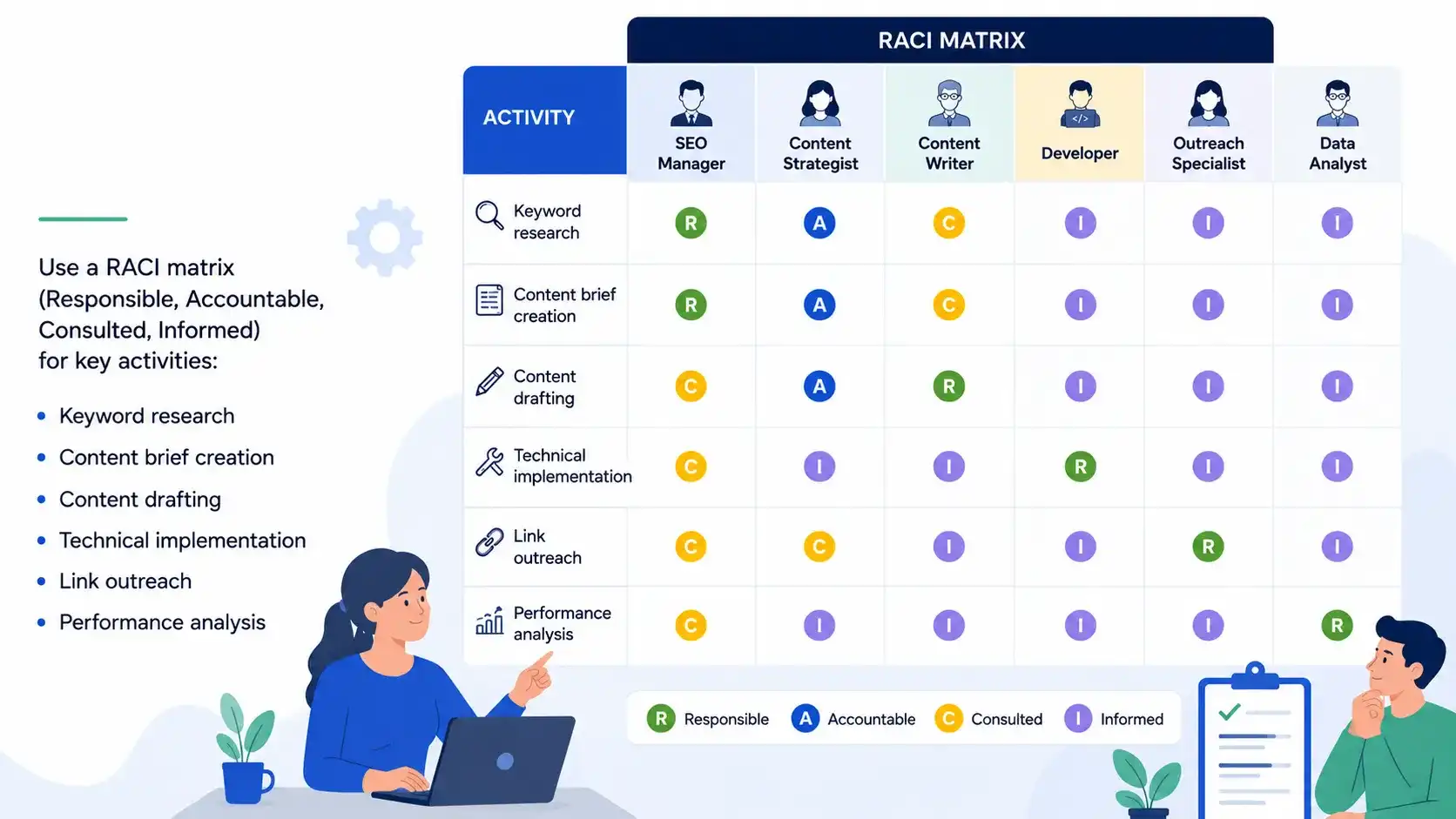
Use a RACI matrix (Responsible, Accountable, Consulted, Informed) for key activities:
- Keyword research
- Content brief creation
- Content drafting
- Technical implementation
- Link outreach
- Performance analysis
Step 3: Select Core Tools (Week 2)
Choose platforms for:
- Project management: Asana, Monday.com, or Trello for task tracking
- SEO research: Ahrefs, Semrush, or seoClarity
- Content collaboration: Google Docs, Notion, or Contentful
- Communication: Slack channels dedicated to SEO updates
- Reporting: Google Data Studio, Looker, or custom dashboards
Teams using collaboration tools report 30% productivity gains (McKinsey via Agiled, 2026). Tool choice matters less than consistent adoption.
Step 4: Create Process Templates (Week 3)
Build reusable templates for:
- Content brief (includes keyword, structure, word count, internal links)
- Technical audit report (findings, priority, implementation owner, deadline)
- Link outreach sequence (prospect research, email templates, follow-up cadence)
Templates reduce decision fatigue and ensure quality consistency.
Step 5: Establish Cadence & Meetings (Week 3-4)
Define recurring touchpoints:
- Daily standup (15 min): What did you complete yesterday? What are you working on today? Any blockers?
- Weekly planning (60 min): Review priorities, assign new work, discuss roadblocks
- Monthly retrospective (90 min): What's working? What should we change?
- Quarterly audits: Comprehensive site health review (Seomator recommends quarterly as standard, 2026)
Step 6: Pilot & Iterate (Month 2)
Run the workflow on one project. Gather feedback:
- What felt smoother?
- Where did confusion persist?
- What tools went unused?
Adjust before rolling out team-wide.
The biggest workflow failure mode: over-engineering on day one. Start simple—clear ownership and a shared task board—then add complexity as gaps emerge.Team Collaboration in SEO Workflows
With 87% of SEO companies now operating as fully hybrid teams (Gitnux, 2026), workflow design must account for distributed collaboration, not just co-located teamwork.
Async-First Communication
Hybrid and remote teams need asynchronous communication defaults:
- Written project briefs instead of verbal handoffs
- Recorded video walkthroughs for complex technical changes
- Shared documentation as single source of truth
- Status updates in project tools rather than requiring meetings
86% of employees cite lack of collaboration or ineffective communication as the main cause of workplace failures (Salesforce via Agiled, 2026). Async-first workflows reduce communication breakdowns.
Visibility & Transparency
Everyone should see:
- What's in progress across the team
- What's blocked and why
- What's launching this week
Use public Slack channels for updates instead of DMs. Make dashboards accessible to all stakeholders.
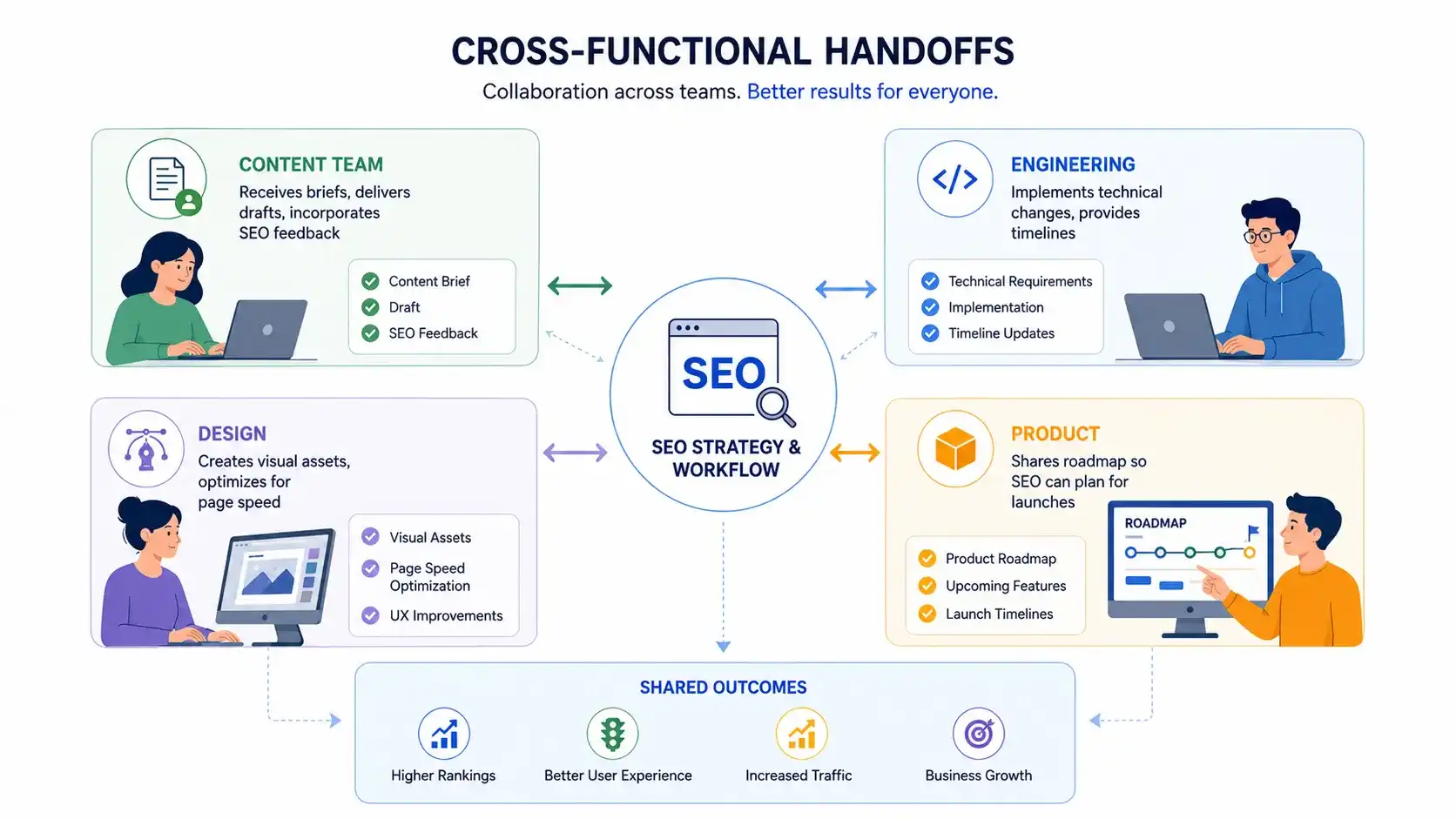
Cross-Functional Handoffs
SEO rarely lives in isolation. Workflows must integrate:
- Content team: Receives briefs, delivers drafts, incorporates SEO feedback
- Engineering: Implements technical changes, provides timelines
- Design: Creates visual assets, optimizes for page speed
- Product: Shares roadmap so SEO can plan for launches
McKinsey Global Institute research analyzing productivity across distributed teams found that organizations using collaboration platforms report 30% higher productivity compared to email-centric workflows, with the productivity gap widening as team size increases beyond five members (McKinsey via Agiled, 2026).
Common collaboration anti-patterns
- Hero culture: One person does everything, creating bottlenecks
- Approval theater: Excessive sign-offs slow progress without improving quality
- Tool sprawl: Using 10+ disconnected tools instead of an integrated stack
- Meeting bloat: Synchronous discussions for information that could be shared async
Hybrid teams (2-3 days remote) show 115% baseline productivity, while full-remote teams with collaboration tools hit 125% productivity (Gitnux, 2026). The key difference: deliberate workflow design, not location.
Automation and AI Integration
AI-powered workflow automation cuts content production time by 60-80% while reducing costs by 85% (Digital Applied, Contadu, 2024-2025), but effective integration requires identifying which tasks to automate and which require human judgment.
High-Value Automation Opportunities
Research automation:
- Keyword clustering and grouping
- SERP feature extraction
- Competitor content gap analysis
- Backlink monitoring and alerting
Content workflow automation:
- Outline generation from keyword research
- First draft creation (requires human editing)
- Meta description suggestions
- Internal linking recommendations
Technical automation:
- Crawl scheduling and issue detection
- Schema markup generation
- Image compression and optimization
- Broken link monitoring
Reporting automation:
- Rank tracking dashboards
- Traffic and conversion reporting
- Automated weekly/monthly email summaries
What NOT to automate (yet)
64% of marketers cite productivity as the top metric for AI tool effectiveness, but quality remains a human responsibility (HubSpot via SeoProfy, June 2026):
- Strategic decisions: Which keywords to target, content strategy direction
- Brand voice and messaging: AI-generated content requires editorial oversight
- Relationship building: Link outreach and digital PR need authentic human connection
- Quality assurance: Final content review before publishing
Integration patterns
Pattern 1: AI-first, human-review
AI generates first draft → human editor refines → SME reviews → publish
Time savings: 60-70%
Pattern 2: Human-guided, AI-assisted
Human creates outline → AI expands sections → human integrates and polishes
Time savings: 40-50%
Pattern 3: Hybrid workflow
AI handles research aggregation → human synthesizes insights → AI optimizes formatting → human final QA
Time savings: 50-60%

Common AI integration mistakes:
- Publishing AI-generated content without human review (quality suffers)
- Over-automating strategy decisions (loses competitive differentiation)
- No quality benchmarks for AI output (can't measure if automation improves or hurts)
Measuring Workflow Efficiency
Workflow efficiency metrics should track both output (how much gets done) and outcome (how well it performs), measured across time-to-completion, quality scores, and business impact.
Key Performance Indicators
Efficiency metrics:
- Cycle time: Days from project kickoff to publication
- Throughput: Number of content pieces or technical implementations completed per week
- Bottleneck identification: Which stage has the longest queue time
- Revision rate: How often does work require rework
Quality metrics:
- SEO score on publication: Use tools like Surfer, Clearscope, or MarketMuse
- Post-publish error rate: How many pieces need corrections after going live
- Editorial feedback scores: Consistent rating system for content quality
Business impact metrics:
- Time to ranking: How long until published content reaches page 1
- Conversion rate: Traffic quality, not just volume
- ROI by project type: Which workflows deliver highest returns (Thought leadership SEO delivers 748% ROI vs basic content at 16% per the chart above)
Benchmark targets
Based on industry data:
- Content production: 2,500-word articles should take 8-12 hours from brief to publish with structured workflow
- Technical implementations: Site-wide schema deployment: 2-4 weeks with proper planning
- Link building: Expect 3-5 high-quality placements per month per outreach specialist
Analysis of over 100,000 SEO audits by Seomator found that businesses conducting quarterly audits (every 3 months) maintain 23% higher average site health scores compared to annual audits, demonstrating that workflow cadence directly impacts technical performance (Seomator, 2026).
Dashboard setup
Build a single workflow dashboard tracking:
- Current projects by stage
- Overdue tasks
- This month's completions vs target
- Quality scores week-over-week
Weekly review meetings should reference this dashboard as the starting point.
Advanced: Hybrid Team Workflow Optimization
If you're already running structured workflows, hybrid team optimization focuses on maximizing the productivity gains that come from blending remote flexibility with in-person collaboration, particularly the 115-125% productivity boost hybrid models can deliver (Gitnux, 2026).
Optimize for synchronous vs asynchronous
Reserve synchronous time for:
- Strategic planning sessions requiring real-time discussion
- Creative brainstorming where ideas build on each other
- Conflict resolution or sensitive feedback
- Onboarding new team members
Default to asynchronous for:
- Status updates and progress reports
- Routine approvals that don't require discussion
- Research sharing and documentation
- Individual deep work phases (content creation, technical implementation)
Hybrid-specific workflow patterns
Pattern: Office days for collaboration-heavy work
Schedule in-person days for kickoffs, retrospectives, and cross-functional alignment. Remote days for execution-focused work.
Pattern: Timezone-aware handoffs
Distributed teams can achieve 24-hour productivity cycles. US team completes research → hands off to APAC team for initial drafts → EU team does editorial review → US team publishes.
Pattern: Remote-first documentation
Even if some team members are co-located, document everything as if the whole team is remote. Prevents information silos.
The productivity data shows hybrid teams outperform both fully in-office and fully remote setups (Gitnux, 2026), but only when workflows are designed for hybrid—not when remote work is treated as an exception to office-first processes.
Cautions
Don't implement hybrid workflows until:
- Basic workflow structure is solid (roles, tools, processes defined)
- Team size exceeds 3 people (coordination overhead makes it worthwhile)
- You have project management tools that support distributed visibility
Tools & Resources
The best workflow tool stack combines Ahrefs or Semrush for SEO research, Asana or ClickUp for project management, and Google Data Studio for reporting, though your specific needs will depend on team size and project complexity.
Recommended Tools
SEO Research & Analysis:
- Ahrefs - Comprehensive keyword research, backlink analysis, content gap identification | Best for: Agencies and in-house teams | $129-$999/month
- Semrush - All-in-one SEO platform with workflow templates | Best for: Teams wanting integrated workflow features | $139.95-$499.95/month
- seoClarity - Enterprise platform with time tracking | Best for: Large teams needing detailed allocation data | Custom pricing
Project Management:
- Asana - Flexible task management with SEO workflow templates | Best for: Teams under 20 people | Free-$24.99/user/month
- ClickUp - Customizable workflows with built-in time tracking | Best for: Teams wanting all-in-one solution | Free-$19/user/month
- Monday.com - Visual workflow builder | Best for: Visual thinkers, creative teams | $9-$19/user/month
Content Collaboration:
- Notion - Wikis, docs, and databases in one platform | Best for: Documentation-heavy workflows | Free-$18/user/month
- Google Workspace - Docs, Sheets, Drive for real-time collaboration | Best for: Teams already in Google ecosystem | $6-$18/user/month
Reporting & Analytics:
- Rankety Flow Framework - AI-powered SEO workflow analysis that maps bottlenecks, prioritizes actions, and turns audit findings into an execution plan | Best for: Teams that need faster SEO task planning and reporting
- Google Data Studio (Looker Studio) - Free dashboard builder | Best for: Budget-conscious teams | Free
- Databox - Pre-built SEO dashboard templates | Best for: Quick setup | $47-$249/month
Learning Resources
- Ahrefs YouTube channel - SEO workflow tutorials
- Semrush Academy - Free certification courses
- Search Engine Journal - Industry best practices
Getting Started with Your First Workflow
Open a new Asana or ClickUp project right now and create five columns: Backlog, Research, In Progress, Review, and Done—you can refine the workflow later, but this basic structure will immediately reduce coordination confusion.
Your first three steps:
Step 1 (next 10 minutes):
Set up the basic board structure. Add one task to each column as an example so team members understand what belongs where. Invite your team and share a 2-minute video walkthrough.
Step 2 (this week):
Move your next three SEO projects into the Backlog column. Break each into concrete tasks (write content brief, conduct keyword research, draft article, etc.). Assign owners to each task.
Step 3 (within 2 weeks):
Schedule a 15-minute weekly standup where each person shares: What did I complete? What am I working on? What's blocking me? This single meeting eliminates 80% of coordination confusion.
Starting simple matters more than starting perfect. Teams that begin with lightweight workflows and iterate based on friction points achieve faster adoption than those who over-engineer upfront.
Frequently Asked Questions
What's the difference between an SEO workflow and an SEO strategy?
An SEO strategy defines what you'll optimize for (target keywords, content themes, technical priorities), while an SEO workflow defines how your team will execute that strategy (processes, roles, tools, timelines). Strategy is the destination; workflow is the vehicle that gets you there.
How long does it take to implement a workflow framework?
Basic workflow implementation takes 2-4 weeks for a small team (3-5 people) using the six-step process outlined above. Larger teams or organizations requiring cross-functional alignment may need 6-8 weeks. According to seoClarity's task time estimates, keyword research and analysis alone takes 8-10 hours ongoing (seoClarity, 2024-2025), so factor in learning curves for new processes.
Should SEO workflows be the same for every project type?
No—adapt workflow complexity to project scope. Simple blog posts need lightweight workflows (brief → draft → review → publish), while technical migrations require comprehensive workflows with multiple QA gates. The core stages (research, planning, execution, measurement) stay consistent, but detail depth varies based on project risk and complexity.
What's the ROI of implementing structured SEO workflows?
Organizations using collaboration tools within structured workflows report 30% productivity gains (McKinsey via Agiled, 2026), while content workflow automation delivers 85% cost reductions (Contadu, June 2024). For a team spending $200K annually on SEO, a 30% efficiency gain returns $60K in reclaimed time or increased output capacity.
How do you prevent workflows from becoming bureaucratic?
Build flexibility into your framework—define clear ownership and quality gates, but avoid requiring approvals that don't improve outcomes. If a process step doesn't prevent errors or improve quality, remove it. The 2025 industry data shows optimal time allocation (Digidop, 2025), but individual projects should adapt those benchmarks rather than follow them rigidly.
Can solo SEO consultants benefit from workflow frameworks?
Yes—solo practitioners benefit from documented workflows that ensure consistency across client projects and reduce decision fatigue. While collaboration tools matter less for solo work, process templates (content briefs, audit checklists, outreach sequences) prevent quality inconsistencies. SEO professionals dedicate 26 hours per week to optimization tasks on average (Search Engine Journal via ROI Amplified, 2025); structure helps maximize that time.
How often should SEO workflows be audited and updated?
Review workflows quarterly in your retrospective meetings, asking what's working and what's creating friction. Major updates should align with changes in team size, tool stack, or SEO algorithm updates. Seomator's analysis of 100K+ audits recommends quarterly cadence as standard for most businesses (Seomator, 2026)—apply the same thinking to workflow reviews.
Conclusion
The most important takeaway: start simple with clear task ownership and a shared tracking system, then layer in complexity only where coordination breaks down.
SEO workflow frameworks transform how teams execute search optimization—from ad-hoc tactics to systematic processes that scale. Whether you're implementing AI automation to capture 60-80% time savings, optimizing hybrid team collaboration for 30% productivity gains, or simply documenting your first process templates, structured workflows deliver measurable improvements in both efficiency and output quality.
The SEO services market's growth to $83.98 billion in 2026 reflects increasing organizational investment in search, but that investment only pays off when teams execute consistently. Frameworks provide that consistency.
Your next step: Set up your first workflow board today using the Getting Started guide above. Begin with one project, measure what changes, and iterate from there.