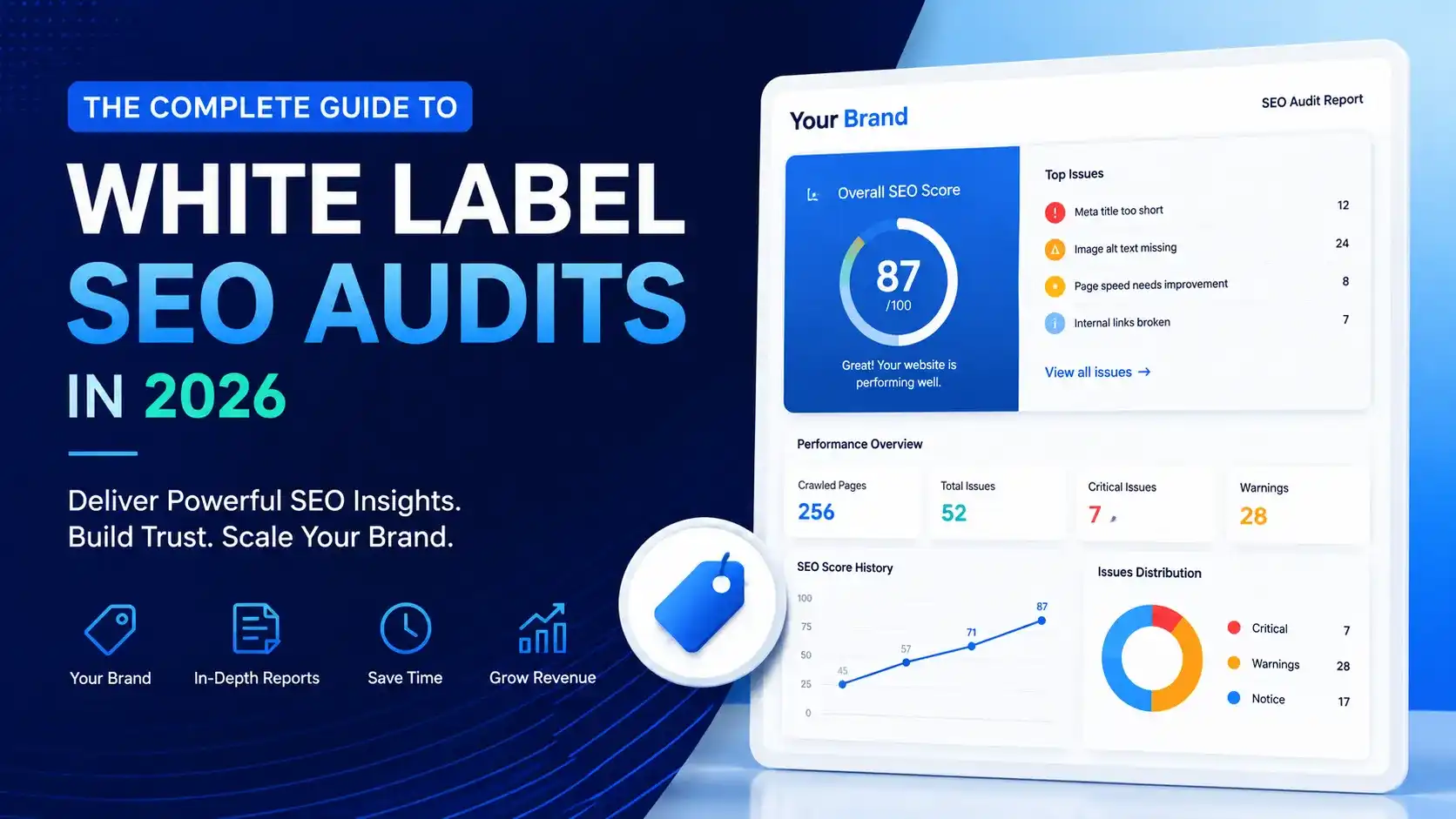
The Complete Guide to White Label SEO Audits in 2026
The SEO services market hit $108.28 billion in 2026, growing 16.8% year-over-year (Companies History, 2026). That explosive growth creates opportunity, but most agencies can't hire fast enough to meet demand. White label SEO audits solve this problem by letting you deliver expert analysis under your brand while your partner handles the technical work.
This guide shows you exactly how white label SEO audits work, what they cost, and how to choose the right provider. You'll learn why 73% of agencies now use white label services (Demand Local, 2026) and how outsourcing the right services can double your growth rate. We'll cover pricing models, quality standards, and the exact steps to integrate white label audits into your workflow.
Whether you're a digital marketing agency looking to expand your service offerings or a consultant who needs technical depth without hiring specialists, this guide gives you a framework for making smart outsourcing decisions. Let's start with what white label SEO audits actually include.
Key Takeaways
- White label SEO audits let agencies deliver expert analysis under their brand without building in-house teams
- Agencies using white label services achieve 34% higher client retention and 20% profit margins (DashClicks, Amra and Elma, 2025-2026)
- Pricing ranges from $500 for basic audits to $30,000 for enterprise analysis (WebTonic, 2026)
- The SEO services market grew to $108.28 billion in 2026, up 16.8% year-over-year (Companies History, 2026)
- Choose providers based on deliverable quality, turnaround time, and seamless white labeling capabilities
What Are White Label SEO Audits?
White label SEO audits are comprehensive website analyses performed by a specialized provider and delivered under your agency's branding. The white label marketing services market reached $99.19 billion by 2026, growing at 12.3% annually (Demand Local, 2026). These audits examine technical SEO, on-page optimization, content quality, backlink profiles, and competitive positioning.
Your white label partner runs the analysis using professional tools and expertise. They document findings, prioritize recommendations, and format everything in your template. The client sees only your brand, your logo, and your contact information. You maintain the relationship while your partner provides the technical depth.
This model works because it separates client management from technical execution. You don't need to master every SEO tool or hire specialists for fluctuating workload. Your partner handles the analysis while you focus on strategy and client relationships.
The chart shows how white label services improve profitability. Agencies using white label partners achieve 20% margins compared to 17.5% for those doing everything in-house. Top performers hit 43% by combining specialization with strategic outsourcing (Predictable Profits, Amra and Elma, 2025-2026).
How White Label Differs from Reselling
White label means invisible partnership. The provider never contacts your client or shows their brand. Reselling typically involves visible third-party involvement, where clients know you're working with another company. White label preserves the illusion that you handle everything internally.
This distinction matters for client trust. When you present an audit under your brand, clients see you as the expert. They don't worry about information sharing or multiple points of contact. You control the relationship completely.
Why White Label SEO Audits Matter
Agencies that outsource 40-60% of services grow 2.3 times faster and achieve profit margins 18-22% higher than agencies doing everything in-house (Amra and Elma, 2025). White label audits let you scale without the overhead of hiring, training, and managing SEO specialists. You can take on more clients immediately.
The quality advantage matters too. Your white label partner specializes in SEO analysis. They run hundreds of audits and stay current on algorithm updates. You get institutional knowledge without building it yourself.
Speed creates competitive advantage. When a prospect requests an audit, you can deliver in days instead of weeks. Quick turnaround wins deals, especially against agencies that need to hire or train before they can start work.
Agencies that strategically outsource 40-60% of their services grow 2.3 times faster and achieve profit margins 18-22% higher than agencies attempting to deliver everything in-house, according to 2025 analysis by Amra and Elma comparing growth trajectories across 200+ digital marketing agencies.
Client retention improves dramatically. Agencies with white label SEO achieve 34% higher retention rates (DashClicks, 2025). Consistent quality and faster delivery keep clients satisfied. They don't see the behind-the-scenes partnership, they just experience better results.
Market Demand for SEO Services
US organizations spent $119.4 billion on SEO consulting in 2025 (Resourcera, 2026). That spending continues growing as businesses recognize organic search as essential marketing infrastructure. The companies that can deliver quality SEO at scale win this market.
Your clients don't care how you deliver results. They want rankings, traffic, and revenue. White label partnerships let you meet that demand without building massive internal teams. You stay nimble while competing against larger agencies.

Benefits for Agencies
White label SEO audits transform agency economics by converting fixed costs into variable costs. Instead of paying salaries whether you have work or not, you pay for audits only when clients need them. This improves cash flow and reduces risk during slow periods.
The profit margins speak for themselves. Agencies using white label services achieve 20% net margins compared to 17.5% for in-house operations (Predictable Profits, Amra and Elma, 2025-2026). That 2.5-point difference compounds over time, funding growth initiatives other agencies can't afford.
Faster Client Onboarding
You can start delivering value immediately. When you win a new SEO client, the first deliverable is typically an audit. With white label partnerships, you can have that audit in the client's hands within 5-7 business days. In-house teams often take 2-3 weeks to complete thorough analysis.
This speed matters during the critical first 30 days of client relationships. Quick wins build confidence. Clients see you as responsive and efficient, which reduces early-stage churn.
Expanded Service Offerings
White label audits let you serve clients you'd otherwise turn away. When a prospect needs comprehensive technical SEO analysis but you specialize in content or paid advertising, you don't have to decline the work. Your (white label)[] partner provides the expertise while you maintain the relationship.
This expands your addressable market. You can pitch full-service SEO without hiring a team of technical specialists. The average agency works with 10-15 active clients; white label partnerships let you grow that number without proportional staff increases.
[INTERNAL-LINK: full-service SEO packages → how to bundle audits with ongoing optimization]
The data shows clear retention advantages. Agencies using white label SEO keep 89% of clients year-over-year, compared to 58% for project-based agencies. Professional services firms retain 84% on average, with top performers exceeding 95% (Agiled, 2026). Consistent quality drives these numbers.
Risk Reduction
White label partnerships reduce the financial risk of expanding service offerings. You don't invest in tools, training, and salaries before you have clients. Instead, you test the market with minimal upfront cost. If SEO audits don't gain traction with your client base, you haven't committed to long-term overhead.
This flexibility matters for smaller agencies and solo consultants. You can compete with larger firms on service breadth without matching their resources. Your (white label)[/white-label-seo] partner provides the infrastructure while you focus on sales and client management.
What's Included in a White Label SEO Audit
A comprehensive white label SEO audit covers technical infrastructure, on-page optimization, content analysis, backlink profile evaluation, and competitive benchmarking. The median SEO ROI hits 748%, returning $7.48 for every dollar spent, with real estate seeing 1,389% returns (First Page Sage, 2025). Quality audits identify the issues limiting that return potential.
Technical analysis examines site speed, mobile responsiveness, crawlability, indexation status, and structured data implementation. Your provider checks for broken links, redirect chains, duplicate content, and XML sitemap errors. They verify that search engines can efficiently access and understand your client's site.
On-page optimization review covers title tags, meta descriptions, heading structure, keyword targeting, and internal linking. The audit identifies pages missing optimization opportunities and flags keyword cannibalization issues where multiple pages compete for the same terms.
Content Quality Assessment
(Content analysis)[/content-quality-checker] evaluates depth, relevance, freshness, and engagement metrics. Your white label partner compares your client's content against top-ranking competitors. They identify thin content that needs expansion and opportunities for new content that targets valuable search queries.
This section typically includes keyword gap analysis showing terms competitors rank for that your client doesn't. These gaps become your content roadmap for the next 3-6 months.
Backlink Profile Analysis
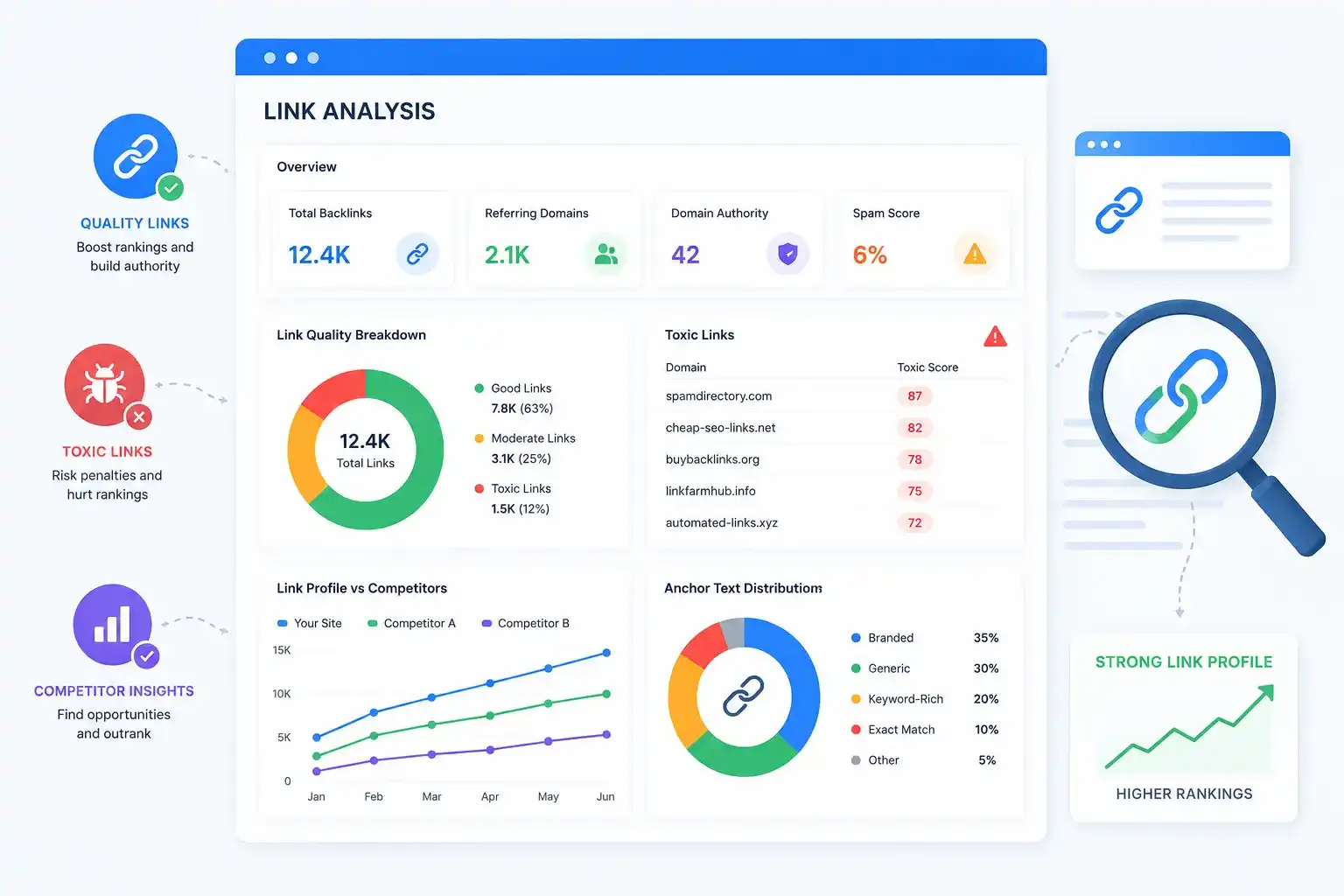
Link analysis examines the quantity, quality, and relevance of inbound links. Your provider identifies toxic links that could trigger penalties and compares your client's link profile against competitors. They highlight link-building opportunities through competitor analysis and content gaps.
The audit includes anchor text distribution analysis to ensure natural-looking patterns. Overoptimized anchor text signals manipulation to search engines, so balancing branded, generic, and keyword-rich anchors matters.
Competitive Benchmarking
Your white label provider analyzes 3-5 direct competitors, documenting their SEO strategies. This section covers keyword targeting, content approaches, technical implementations, and link-building tactics. You get specific recommendations based on what's working in your client's niche.
(Competitive analysis)[/seo-competitor-checker] prevents wasted effort. Instead of guessing which tactics might work, you see what's already driving results for similar businesses. This data-driven approach reduces risk and accelerates time to results.
Actionable Recommendations
The audit concludes with prioritized recommendations. Your white label partner categorizes issues by impact and implementation difficulty. High-impact, easy-to-fix issues come first. Complex technical projects that require developer resources get flagged separately.
Each recommendation includes expected impact, implementation steps, and success metrics. This actionable format lets your client's team start work immediately without needing to interpret findings.
Pricing Models and ROI
SEO audit pricing varies dramatically based on scope and depth. Budget audits cost $500-$3,500, mid-range audits run $3,000-$10,000, comprehensive audits range from $7,500-$15,000, and enterprise audits start at $15,000 and can exceed $30,000 (WebTonic, 2026). For agencies, 43% charge clients $101-$750 for SEO audits, though comprehensive audits command higher rates.
White label pricing typically falls below retail because you're buying at wholesale. Your provider might charge $1,500 for an audit you sell at $3,000. That 50% margin covers your sales effort, client management, and project coordination. You make money without doing the technical work.
SEO audit pricing in 2026 ranges from $500 for basic automated analysis to over $30,000 for enterprise-level comprehensive audits, with 43% of agencies charging clients between $101 and $750 for standard audits, according to market research by WebTonic covering pricing models across 500+ digital marketing agencies.
Subscription vs Per-Audit Pricing
Some white label providers offer subscription models. You pay $500-$2,000 monthly for a set number of audits. This works well if you have predictable volume. Per-audit pricing gives you flexibility but typically costs more per unit.
Calculate your expected volume before committing. If you'll order 4+ audits monthly, subscriptions usually save 20-30% compared to one-off pricing. Smaller agencies with inconsistent demand benefit from pay-as-you-go models.
Calculating ROI for Clients
SEO delivers measurable returns. The median ROI of 748% means smart implementations generate substantial revenue (First Page Sage, 2025). When you present audit findings to clients, quantify the opportunity. Show how fixing technical issues could increase crawl efficiency by 40%, or how targeting new keywords could capture 5,000 additional monthly visitors.
This value-based approach justifies premium pricing. Clients don't balk at $5,000 audits when you demonstrate $50,000 in potential annual revenue. Frame audits as investments, not expenses.
Hidden Costs to Consider
Factor in your time for project coordination. You'll spend 2-4 hours per audit managing client communication, reviewing deliverables, and presenting findings. This labor cost affects your true margin, especially if you're billing hourly for other work.
Some providers charge extra for rush delivery, branded templates, or revision rounds. Clarify these costs upfront. The cheapest provider often becomes expensive when you factor in hidden fees and poor communication that requires extra coordination time.
How to Choose a White Label SEO Provider
The quality of audit deliverables determines client satisfaction and retention. Professional services firms keep 84% of clients annually, with top performers retaining over 95% (Agiled, 2026). Your white label provider directly impacts those metrics, so selection criteria matter more than price.
Start by evaluating sample audits. Request full deliverables, not marketing materials. Read through the technical analysis, recommendations, and presentation formatting. Can you confidently present this work under your brand? Would your clients find it clear and actionable?
Communication responsiveness predicts operational headaches. Providers who take days to answer pre-sale questions will be equally slow during projects. Test their response time and clarity before committing.
Key Selection Criteria
Turnaround time affects your ability to win and retain clients. Ask about standard delivery timeframes and rush options. Most quality providers deliver within 5-10 business days. Faster turnaround typically costs more but can be worth it for urgent client needs.
White labeling capabilities vary significantly. Some providers offer basic logo swapping, while others provide fully customizable report templates matching your brand guidelines. Review template samples to ensure the output looks native to your agency.
Expertise verification matters. Ask about the team's background, certifications, and specializations. Providers with former in-house SEO managers understand both technical analysis and client communication. Pure technicians often produce reports that confuse non-technical clients.
Questions to Ask Potential Providers
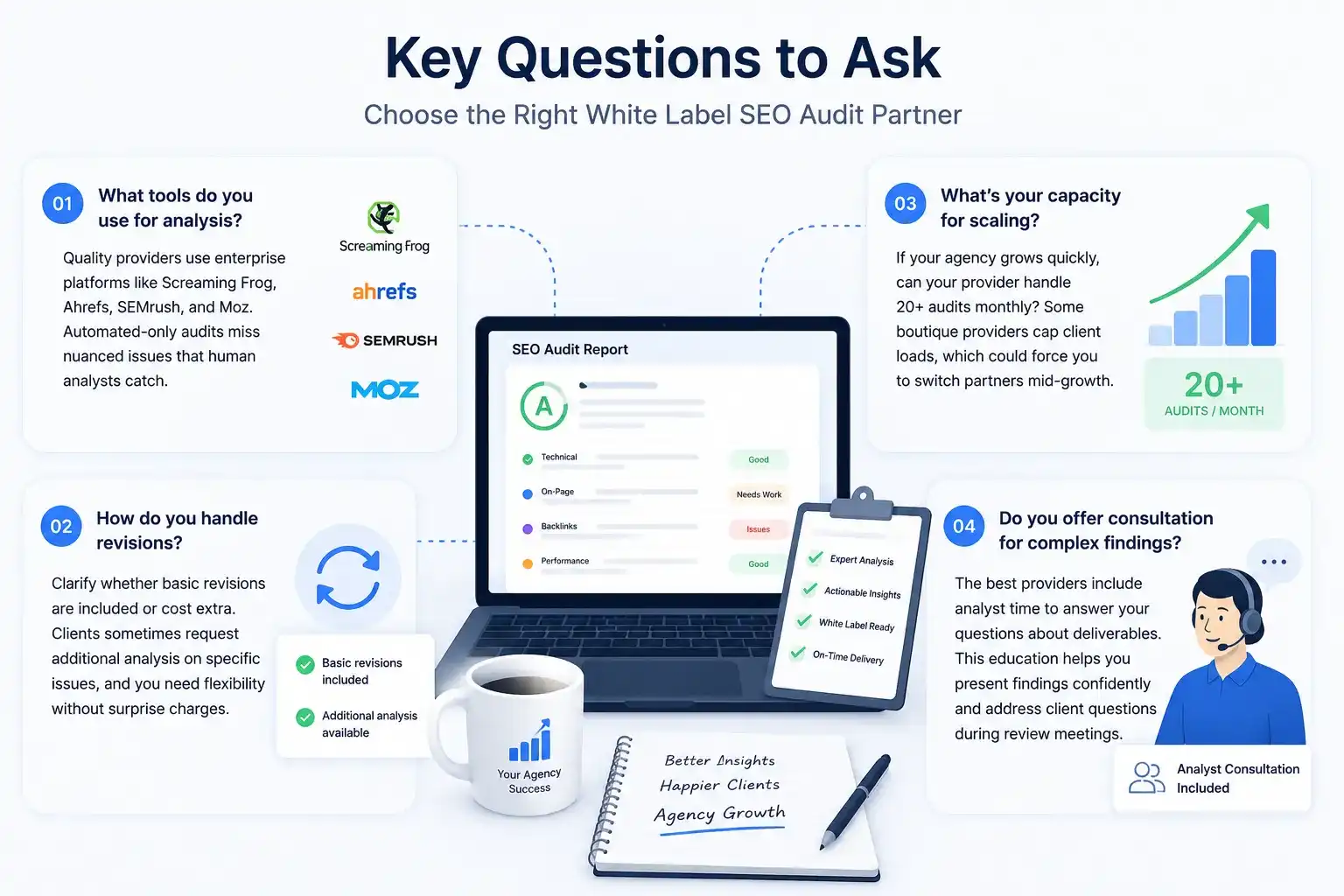
What tools do you use for analysis? Quality providers use enterprise platforms like Screaming Frog, Ahrefs, SEMrush, and Moz. Automated-only audits miss nuanced issues that human analysts catch.
How do you handle revisions? Clarify whether basic revisions are included or cost extra. Clients sometimes request additional analysis on specific issues, and you need flexibility without surprise charges.
What's your capacity for scaling? If your agency grows quickly, can your provider handle 20+ audits monthly? Some boutique providers cap client loads, which could force you to switch partners mid-growth.
Do you offer consultation for complex findings? The best providers include analyst time to answer your questions about deliverables. This education helps you present findings confidently and address client questions during review meetings.
Red Flags to Avoid
Cookie-cutter reports signal automated-only analysis. Every website has unique issues, so deliverables should reflect site-specific findings. Generic recommendations like "improve site speed" without specific technical guidance waste client money.
Slow communication predicts operational problems. If a provider takes 48+ hours to respond during sales conversations, expect worse during active projects. You need partners who respond within business hours.
No samples or references suggest inexperience. Established providers eagerly share past work and client testimonials. Resistance to providing samples often indicates quality problems they're hiding.
Unrealistic promises about rankings or traffic sound appealing but create client disappointment. Audits identify problems; they don't guarantee specific outcomes. Providers making performance promises likely won't deliver.
Common Challenges and Solutions
The biggest challenge agencies face with white label SEO is quality consistency. You're trusting an external partner with your reputation, so deliverable quality must stay high across every project. Sixty-five percent of businesses have worked with multiple SEO providers (Resourcera, 2026), showing clients readily switch when quality drops.
Establish quality standards upfront. Create a checklist covering required analysis sections, minimum recommendation counts, and presentation standards. Share this with your white label provider before the first project. Review early deliverables thoroughly and provide feedback immediately.
Communication gaps create client-facing problems. Your provider might identify technical issues you don't fully understand, making client presentations awkward. Schedule debriefs with your white label analyst before client meetings. Ask clarifying questions and request layman's explanations for complex technical findings.
Managing Client Expectations
Clients often expect immediate results from audit implementations. Set realistic timelines during sales conversations. SEO improvements typically take 3-6 months to show meaningful traffic impact. Position audits as the roadmap, not the destination.
We've found that framing audits as "diagnostic scans" rather than "solutions" helps clients understand they're seeing problems, not fixes. The audit finds issues; the implementation work fixes them. This distinction prevents disappointment when rankings don't jump immediately after audit delivery.
Scope creep happens when clients request additional analysis beyond the original agreement. Your white label provider delivers a specific scope; client requests for "just one more thing" can create awkward conversations. Define scope clearly in proposals and explain that additional analysis requires separate projects.
Handling Technical Questions
Clients sometimes ask technical questions you can't answer immediately. Don't fake expertise. Tell clients you'll research with your technical team and follow up within 24 hours. Then contact your white label provider for answers.
This honesty builds trust more effectively than stumbling through technical explanations. Clients respect agencies that know when to consult specialists rather than pretending universal knowledge.
Maintaining Brand Consistency
White label deliverables must match your agency's tone and style. Generic corporate language feels disconnected if your agency uses casual, friendly communication. Request customization of not just logos but writing style, terminology, and formatting.
Some providers charge for heavy customization. Factor this into pricing decisions. Perfect brand alignment costs more but prevents client confusion when audit reports sound different from your other communications.
Scaling Without Quality Loss
Rapid growth tests white label partnerships. Your provider handled three audits monthly comfortably, but can they deliver fifteen without quality decline? Discuss capacity planning before you scale client acquisition.
Consider diversifying providers once you reach higher volumes. Using two or three white label partners creates redundancy. If one becomes overloaded or experiences quality issues, you have alternatives without disrupting client work.
White Label vs In-House SEO Audits
Building in-house SEO audit capabilities requires significant investment. You need analysts who understand technical SEO, access to enterprise tools ($200-$500 monthly per seat), and enough volume to keep specialists busy. Top-performing agencies achieve 43% profit margins by mixing in-house and white label strategically (Predictable Profits, 2025).
The breakeven point typically hits around 8-10 audits monthly. Below that volume, white label costs less than employing a full-time analyst. Above that threshold, in-house becomes financially attractive if you can maintain consistent demand.
Quality control feels easier in-house because you directly manage the analysts. However, specialized white label providers often deliver higher quality because audits are their core focus. Your generalist SEO analyst splits time between audits, client calls, and implementation work, while white label specialists do nothing but audits.
When In-House Makes Sense
Large agencies with 20+ active SEO clients benefit from in-house teams. The volume justifies full-time specialists, and direct oversight ensures consistent quality. You can also respond faster to rush requests without coordinating with external partners.
Highly specialized niches sometimes require in-house expertise. If you serve a technical industry with unique SEO considerations, training an in-house analyst on those specifics might make more sense than explaining context to white label partners repeatedly.
When White Label Makes Sense
Agencies under 50 total clients rarely have enough SEO audit volume to justify full-time hires. White label partnerships let you offer professional audits without overhead. You stay agile and profitable while competing with larger agencies.
Seasonal businesses benefit from white label flexibility. If your agency sees demand spikes during certain quarters, you can't realistically hire and lay off specialists. White label partners absorb volume fluctuations without affecting your operations.
SaaS-based white labeling makes even more sense when you need faster turnaround without adding analyst headcount. With Rankety's white label SEO features, agencies can generate branded SEO audit reports, remove platform branding, and deliver client-ready findings quickly. This reduces manual reporting work, keeps labor costs predictable, and lets your team process more audits without waiting on a larger in-house SEO department.
The best model combines both approaches. Keep one in-house SEO analyst for client strategy and implementation oversight, then use white label partners for technical audits and link analysis. This hybrid approach delivers speed and expertise without full overhead.
Cost Comparison
In-house SEO analysts cost $50,000-$85,000 annually for base salary, plus $15,000-$25,000 for benefits, taxes, and overhead. Add $3,000-$6,000 yearly for tools. Total annual cost: $68,000-$116,000. That analyst might complete 100-150 audits annually if audits are their primary focus.
White label costs run $800-$2,500 per comprehensive audit depending on scope and provider. At $1,500 average, 100 audits cost $150,000 annually. The math seems to favor in-house, but that assumes consistent volume and ignores management time.
Factor in recruiting costs, training time, management overhead, and capacity during slow periods. In-house employees require work even when audit demand drops. White label partners only get paid when you have projects.
Hybrid Approach Benefits
Many successful agencies use both. In-house analysts handle client strategy, ongoing optimization, and smaller technical reviews. White label partners handle comprehensive quarterly audits and specialized analysis like international SEO or technical migrations.
This model provides flexibility and depth. Your in-house team maintains client relationships and understands business context. White label specialists bring expertise for complex projects without creating fixed overhead. Agencies using this approach often hit the 32.5% margin range for specialized firms.
Scaling Your Agency with White Label Services
The agencies growing fastest in 2026 don't try to build every capability internally. They identify their core competency, whether that's strategy, content, or paid media, then use white label partners to fill gaps. This focused approach lets them compete at enterprise scale while maintaining small-agency margins and flexibility.
White label partnerships enable vertical scaling, where you serve existing clients more comprehensively, and horizontal scaling, where you acquire more clients. Both paths increase revenue without proportional cost increases. The 73% of agencies now using white label services (Demand Local, 2026) understand this leverage.
Start by documenting your workflow. Map every step from audit order to client delivery, including handoffs, review points, and approval processes. Smooth workflows let you scale volume without chaos. Clunky processes that work fine for 3 audits monthly collapse at 15 audits monthly.
Systematizing Deliverables
Create standard operating procedures for every client interaction. Your audit presentation shouldn't be improvised differently for each client. Develop a template presentation deck, rehearsed talking points, and FAQ responses. Consistency improves quality while reducing preparation time.
Standardization doesn't mean robotic service. Your framework stays consistent while content adapts to each client's specific situation. Think of it like a restaurant that serves custom dishes using standardized recipes and processes.
Building Strategic Partnerships
The strongest white label relationships function as partnerships, not vendor transactions. Share your growth plans with providers. If you're targeting healthcare clients, your provider can develop healthcare-specific audit components. This collaboration creates competitive advantages generic providers can't match.
Regular communication prevents problems. Schedule monthly calls with key white label partners even when you don't have active projects. Discuss industry trends, new services, and process improvements. These relationships compound in value over time.
Packaging Audits with Ongoing Services
Standalone audits generate one-time revenue. Smart agencies package audits as the first step in ongoing SEO retainers. Position the audit as diagnostic work that identifies opportunities, then propose monthly optimization services to implement recommendations.
This approach improves economics dramatically. A $3,000 audit becomes a $3,000 audit plus a $2,500 monthly retainer for 12+ months. Total lifetime value jumps from $3,000 to $33,000+. White label partners often provide both audit and ongoing optimization services, simplifying operations.
Creating Service Tiers
Offer three audit packages: basic, comprehensive, and enterprise. Basic audits suit small businesses with simple sites. Comprehensive audits serve mid-market companies. Enterprise audits handle complex technical implementations for large organizations.
Tiered pricing simplifies sales conversations and accommodates different client budgets. You'll close more deals because prospects can find an option matching their needs. Package pricing also sets clear scope expectations, reducing change requests and scope creep.
Tools & Resources
Quality white label SEO audits rely on enterprise-grade tools that most agencies can't justify purchasing independently. Your provider should use platforms like Screaming Frog for technical crawling, Ahrefs or SEMrush for backlink analysis and keyword research, Google Search Console for performance data, and PageSpeed Insights for speed optimization.
Understanding these tools helps you evaluate deliverables intelligently. When your white label provider identifies 127 broken links using Screaming Frog, you can verify by reviewing the raw data. This verification builds confidence that you're getting thorough analysis.
Essential Tool Categories
Crawler tools examine every page on a website, identifying technical issues like broken links, redirect chains, duplicate content, and missing metadata. Screaming Frog dominates this category for sites under 10,000 pages. Larger sites often require enterprise solutions like Botify or DeepCrawl.
Backlink analysis platforms track who links to your client's site and how those links compare to competitors. Ahrefs, Moz, and Majestic each have strengths. Quality white label providers use multiple sources because no single tool captures every link.
Keyword research tools identify search volume, difficulty, and opportunity for target terms. SEMrush and Ahrefs lead this category, providing data on what competitors rank for and where content gaps exist.
Learning Resources
Google's Search Central documentation provides foundational knowledge for understanding audit findings. When deliverables reference Core Web Vitals or mobile-first indexing, Search Central explains these concepts in detail.
Industry publications like Search Engine Journal and Search Engine Land cover algorithm updates and best practices. Following these sources helps you understand context when white label providers explain why certain recommendations matter.
Complementary Services
White label audits work best alongside other outsourced services. Consider packaging audits with white label content writing, link building, and technical implementation. Offering complete solutions increases client lifetime value and simplifies your operations.
Most white label SEO providers offer multiple services. Building relationships with full-service providers lets you scale offerings without managing multiple vendor relationships.
Getting Started
Begin by identifying 2-3 potential white label providers. Request sample audits and evaluate quality, presentation, and actionability. Schedule calls to discuss their process, turnaround times, and customization options. Don't commit to exclusivity immediately; test multiple providers with smaller projects first.
Create a simple project workflow before your first order. Document who requests audits, how you'll communicate requirements to your provider, your review process, and how you'll present findings to clients. This structure prevents confusion when you're working on multiple simultaneous audits.
Start with one or two existing clients who already trust your work. Offer them discounted audits to test your process. This low-risk approach lets you refine workflows before you sell audits to new clients at full price.
Your First 30 Days
Week 1: Research and vet providers. Request samples, check references, and compare pricing.
Week 2: Select a provider and complete their onboarding process. Customize report templates with your branding.
Week 3: Order your first test audit for a friendly client. Review deliverables thoroughly and provide feedback to your provider.
Week 4: Present findings to your test client. Refine your presentation approach based on client questions and reactions.
After this testing phase, you'll have confidence to market audits broadly. The investment in careful setup pays dividends through smooth execution as volume increases.
[INTERNAL-LINK: agency services pricing guide → how to price white label services for maximum profitability]
FAQ
How long does a typical white label SEO audit take?
Most comprehensive white label SEO audits take 5-10 business days from order to delivery, with 7 days being average for mid-range audits (WebTonic, 2026). Rush delivery in 2-3 days typically costs 30-50% more. Simple automated audits for small sites can be completed in 24-48 hours, while enterprise audits for complex websites with 10,000+ pages may take 15-20 business days.
Can clients tell I'm using a white label provider?
Quality white label providers operate completely invisibly to your clients. All deliverables carry your branding, contact information, and formatting. Providers never contact your clients directly or appear in any client-facing materials. However, poor providers sometimes leave traces like wrong brand names in metadata or inconsistent formatting. Review every deliverable thoroughly before sharing with clients to catch these errors.
What's the difference between white label and private label SEO audits?
The terms are essentially interchangeable in the SEO industry. Both refer to services performed by one company and branded under another company's name. Some providers use "private label" to emphasize exclusive partnership arrangements where you're their only client in a specific geographic area or industry. These exclusive arrangements typically cost more but prevent competitors from accessing the same provider.
How do white label SEO audits compare to automated tools?
Automated SEO tools like Screaming Frog or SEMrush's Site Audit identify technical issues quickly but miss strategic context and nuanced recommendations. White label audits combine automated scanning with human analysis. Analysts interpret findings based on industry knowledge, competitive context, and implementation feasibility. This human expertise justifies the $500-$30,000 price premium over $100-$300 monthly automated tools (WebTonic, 2026).
Should I disclose to clients that I use white label services?
This depends on your service agreements and personal ethics. Legally, you're not required to disclose outsourcing relationships unless your contract specifically requires it. Many agencies present white label work as their own, similar to how law firms use contract attorneys or accounting firms use offshore bookkeepers. However, if a client directly asks whether work is completed in-house, answer honestly. Maintaining trust matters more than concealing operational details.
What happens if a client isn't satisfied with the audit?
Establish revision policies with your white label provider before problems arise. Most providers include one round of reasonable revisions in their base price. If clients request additional analysis beyond the original scope, that typically requires additional payment. Present yourself as the quality gatekeeper, reviewing all deliverables before client delivery. This positions you to catch problems early and request provider revisions before clients see them.
How do I price white label audits for my clients?
Standard markup ranges from 50-100% above your white label cost. If you pay $1,500 for an audit, charge clients $2,250-$3,000. Price based on client sophistication and budget rather than rigid formulas. Enterprise clients expect to pay $7,500-$15,000 for comprehensive audits, while small businesses balk at anything over $2,000. Market positioning also matters; premium-positioned agencies can charge more than budget-focused competitors for identical deliverables.
Conclusion
White label SEO audits provide digital marketing agencies with a proven path to expand service offerings, improve profitability, and scale operations without proportional overhead increases. The 73% of agencies now using white label services (Demand Local, 2026) demonstrate this approach's mainstream acceptance and effectiveness.
Success requires choosing the right provider and implementing efficient workflows. Start with thorough vetting using the criteria outlined in this guide. Test providers with low-risk projects before committing to high-volume partnerships. As you build confidence, expand audit offerings to more clients and package them with ongoing SEO services for maximum lifetime value.
The market opportunity is substantial. With US organizations spending $119.4 billion on SEO consulting in 2025 (Resourcera, 2026) and median SEO ROI hitting 748% (First Page Sage, 2025), clients need expert guidance more than ever. White label partnerships let you meet that demand efficiently.
Ready to add professional SEO audits to your service offerings? Start by requesting samples from three providers this week. Evaluate quality, compare pricing, and test one provider with a friendly client. That simple process positions you to offer white label SEO audits confidently by next month.